
Your finance team processes hundreds or thousands of invoices every month. Each one carries a cost: labour, oversight, error correction, and the professional risk of getting it wrong. AP automation ROI measures whether the investment in automating that process delivers measurable returns, and for most mid-market organisations, the answer is clear.
This article breaks down how AP automation ROI is defined, which metrics matter most, and how you can build a credible business case using real benchmarks and practical formulas. You will also find guidance on where Kefron AP fits into that equation.
Key Takeaways: AP Automation ROI
- AP automation ROI compares the total cost of automation against measurable savings in labour, errors, and late fees.
- Industry benchmarks show that manual invoice processing costs between six and fifteen dollars per invoice.
- Cost per invoice, cycle time, and touchless rate are the three metrics that anchor any ROI calculation.
- Kefron AP reduces invoice processing time by up to 80%, accelerating your path to positive ROI.
- Building a bottom-up business case from your own data produces the most defensible ROI projection.
What Is AP Automation ROI?
AP automation ROI is the financial return your organisation gains by replacing manual accounts payable tasks with automated workflows. It compares the cost of implementing and operating the software against the savings generated in labour, error reduction, early-payment discounts, and avoided late fees.
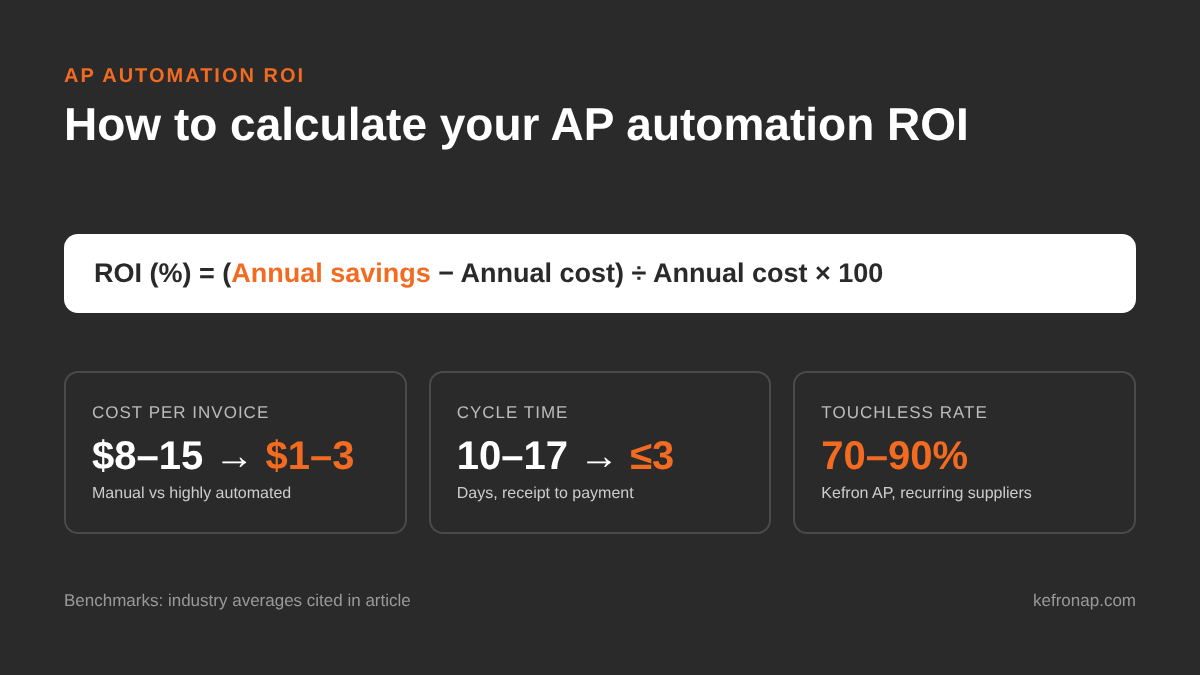
The calculation follows a straightforward formula: subtract the annual cost of the automation solution from the annual savings it produces, divide the result by the annual cost, and multiply by 100. A positive percentage confirms the investment is delivering value.
What makes AP automation ROI distinct from a general technology ROI is the number of measurable inputs available. You can track cost per invoice, processing cycle time, error rates, and discount capture rates before and after implementation. That level of specificity gives finance leaders a credible, auditable business case rather than a vague promise of efficiency.
How Is AP Automation ROI Measured?
Measuring AP automation ROI starts with establishing a baseline: your current cost to process a single invoice from receipt through to payment. According to APQC's cross-industry benchmarking data (2026), the median cost to process an invoice is $6.00, based on data from 5,846 organisations. That figure includes personnel, systems, overhead, and outsourced costs.
Once you have your baseline, project the new cost per invoice after automation. The difference between those two figures, multiplied across your annual invoice volume, gives you your estimated annual savings. Compare that to the total annual cost of the platform, and you have a defensible ROI figure.
Organisations with high manual costs and large invoice volumes see the strongest returns. Research from Ardent Partners shows that best-in-class AP departments achieve per-invoice processing costs roughly 70% below the industry average. That gap represents recoverable value for any team still relying on manual workflows.
Which Metrics Drive AP Automation ROI?
Three metrics anchor a reliable AP automation ROI calculation: cost per invoice, invoice processing cycle time, and touchless processing rate. Each one captures a different dimension of the return.
Cost per Invoice
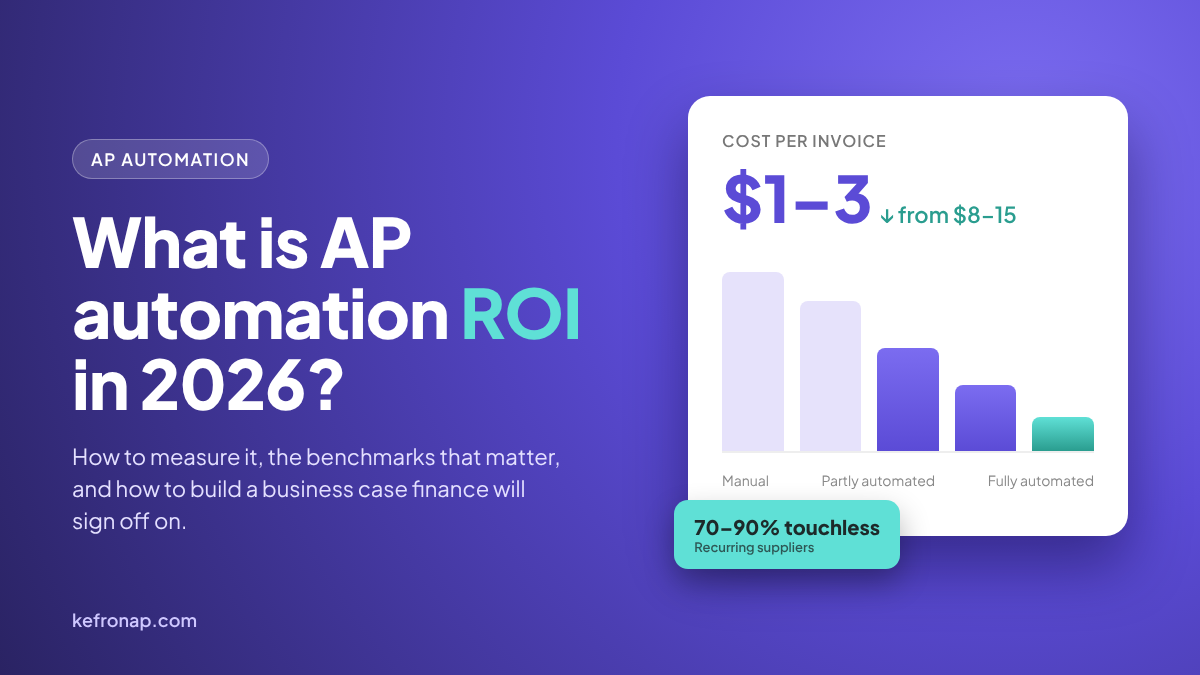
Cost per invoice is the total AP processing cost divided by the number of invoices processed. It is the single most important metric for tracking efficiency gains. A declining cost per invoice over time confirms automation is delivering savings. Industry benchmarks place manual processing between $8 and $15 per invoice; highly automated departments report $1 to $3.
Invoice Processing Cycle Time
Cycle time measures the average number of days from invoice receipt to payment. Organisations with limited automation average around 10 to 17 days per invoice. Highly automated teams cut that to 3 days or fewer. Shorter cycle times unlock early-payment discounts and reduce late-payment penalties, both of which feed directly into ROI. Pancreatic Cancer UK cut its invoice processing time from 63 days to 22 days with Kefron AP.
Touchless Processing Rate
Touchless rate measures the percentage of invoices that move from capture through to ERP posting without manual intervention. It tells you what proportion of your AP volume your team no longer has to handle. Kefron AP achieves 70 to 90% touchless processing for recurring suppliers, freeing your team to focus on invoices that genuinely require judgement. Lambeth Council processes around 7,000 invoices a month at a 66% touch-free rate, while Heritage Parts Centre handles up to 90% of invoices touch-free.
What Cost Savings Does AP Automation Deliver?
AP automation generates cost savings across several categories. Each one contributes to the overall ROI and can be tracked independently.
Labour Cost Reduction
Manual data entry, invoice matching, approval chasing, and error correction consume significant staff hours. Automation handles these tasks, allowing your AP team to redirect their time toward higher-value finance work. The savings compound as your invoice volume grows, because automation scales without requiring additional headcount. Mill Hill School saved 78% of AP staff time, and Riviera Travel saves 32 hours a month on data entry.
Error and Duplicate Payment Prevention
Manual processes introduce errors: miskeyed amounts, duplicate invoices, and misrouted approvals. Each error carries a direct financial cost and an indirect cost in the time required to investigate and correct it. Kefron AP's duplicate invoice detection compares each incoming invoice against everything already processed, checking supplier, number, amount, and date for near matches as well as exact ones.
Early-Payment Discount Capture
Many suppliers offer discounts for early payment, typically 1% to 2% if paid within 10 days. Manual AP departments struggle to capture these because invoices often sit in approval queues past the discount window. Faster invoice processing makes those discounts systematically accessible.
Late-Payment Fee Avoidance
Late payments result in fees, interest charges, and strained supplier relationships. Automated approval routing and configurable payment scheduling eliminate the bottlenecks that cause invoices to miss their due dates. CVS Group reduced invoice approval time by 67% after automating its approval workflows.
How to Calculate AP Automation ROI for Your Organisation
Building a credible ROI projection requires your own data, not just industry averages. Here is a step-by-step approach.
First, establish your baseline cost per invoice. Total all AP-related costs for the past year, including salaries, overhead, late fees, and rework. Divide by the number of invoices processed. Kefron AP's savings calculator can help you benchmark this figure.
Second, estimate your post-automation cost per invoice using conservative assumptions from a proof of concept or published benchmarks for similar invoice volumes.
Third, multiply the per-invoice saving by your annual volume and subtract the annual platform cost. Apply the ROI formula: divide net savings by annual cost and multiply by 100. Many organisations see payback within 12 months; Kefron AP typically delivers payback within 9 to 12 months.
AP Automation ROI in Practice: Kefron AP Customer Results
The numbers below come from Kefron AP customers across different industries, ERPs, and invoice volumes.
- Applegreen (SAP, retail): 92% reduction in invoice processing time across 193 sites in the UK, USA, and Ireland.
- Technicut (Infor, manufacturing): 97% reduction in processing time on around 2,500 invoices a month across three entities.
- Freetrade (NetSuite, fintech): 84% reduction in invoice processing time.
- DAF Truck Services (Keyloop Drive, automotive): 80% reduction in processing time on around 1,000 invoices a month.
- Gold Care Homes (Sage 50, healthcare): paperless AP across 29 sites, saving £30,000 a year.
- Smith Cameron Group (SAP Business One, manufacturing): AP standardised across seven US entities with 99% accuracy.
See more results by industry and ERP in our customer stories.
What Indirect Benefits Contribute to AP Automation ROI?
Direct cost savings are only part of the picture. Several indirect benefits contribute to long-term ROI, even though they are harder to assign a precise dollar figure.
Stronger audit trails reduce compliance risk. Automated systems log every action with timestamps and user IDs, making audit preparation faster and reducing the chance of regulatory penalties. Kefron AP maintains a timestamped audit trail for every invoice processed, with every document stored in a searchable document centre.
Better visibility into cash flow helps your finance team forecast more accurately. Real-time dashboards show outstanding payables, ageing reports, and approval bottlenecks, giving you the data to make informed decisions rather than reacting to surprises.
Improved supplier relationships are another measurable benefit. Consistent, on-time payments build trust with your vendors, which can translate into better terms, priority fulfilment, and a more resilient supply chain.
What Mistakes Should You Avoid When Projecting AP Automation ROI?
The most common error is overstating the achievable touchless rate. Vendor marketing materials often cite best-case figures. Use your own proof-of-concept results instead.
Understating implementation costs is another frequent mistake. Include internal resource time, data migration, and training alongside the software subscription.
Using a one-year ROI horizon can misrepresent the investment. Benefits typically accelerate in years two and three as the system learns your patterns. A three-year horizon gives a more accurate view.
Ignoring adoption risks undermines ROI realisation. According to a 2025 IOFM benchmarking report, AP teams that invest in structured training achieve higher straight-through processing rates and faster returns.
In Conclusion: How to Use AP Automation ROI to Build Your Business Case
AP automation ROI is not an abstract metric. It is a practical tool for justifying investment, setting expectations, and tracking results after go-live. Start by measuring your current state honestly: cost per invoice, cycle time, error rates, and discount capture. Then model the projected improvement using conservative assumptions grounded in your own data.
The organisations that get the strongest returns are those that treat ROI as an ongoing measurement, not a one-time calculation. Track the same metrics quarterly, compare them to your baseline, and adjust your processes where the data points to gaps. With Kefron AP, that measurement starts from the first invoice processed and continues as the platform adapts to your workflows. See Kefron AP in action.
FAQs About AP Automation ROI
What is a good AP automation ROI percentage?
A positive ROI above 50% in the first year indicates a strong investment. APQC's 2026 benchmarking data reports a median 45% cumulative return on finance process automation across 2,476 organisations. Results vary based on invoice volume, current cost baseline, and the touchless rate your team achieves.
How long does it take to see ROI from AP automation?
Most organisations see positive ROI within 9 to 18 months. Kefron AP typically delivers payback within 9 to 12 months, because its guided onboarding gets your team live in weeks rather than months, and its AI-powered extraction reaches 99% accuracy early in the process.
Does AP automation ROI only apply to large enterprises?
No. Mid-market organisations processing more than a few thousand invoices annually see meaningful returns. The fixed platform cost is spread across your invoice volume, so the per-invoice economics improve as volume increases. Kefron AP serves organisations across the mid-market and enterprise spectrum, from professional services firms to consumer packaged goods companies.
What is the biggest driver of AP automation ROI?
The touchless processing rate is the single variable that most influences your per-invoice cost and overall return. Kefron AP achieves 70 to 90% touchless processing for recurring suppliers, which means your team only handles invoices that carry a genuine exception requiring human judgement.
Can I calculate AP automation ROI before implementation?
Yes. Start with your current cost per invoice, estimate the post-automation cost using vendor benchmarks or proof-of-concept data, and apply the standard ROI formula. Kefron AP provides a savings calculator that gives you a baseline projection before you speak to any vendor.