AP Automation for Tire Dealerships: 71% Touch-Free
AP automation for tire dealerships uses AI to capture supplier invoices, match them line by line to...

Accounts payable automation is technology that automatically captures, validates, matches, and routes supplier invoices through approval workflows. It eliminates manual data entry, accelerates payment cycles, and gives finance leaders real-time visibility over every dollar leaving the business. For PE-backed companies, it is one of the fastest-payback, lowest-risk improvements available to the finance function. Yet it rarely makes it into value creation conversations.
This article explains why that omission is costly, how automated invoice processing directly improves working capital, EBITDA, and audit readiness, and what finance leaders in PE-backed businesses should be focused on next.
Accounts payable automation is software that replaces manual invoice handling with automated capture, three-way PO matching, approval routing, and payment processing. Instead of requiring AP clerks to manually key invoice data, chase approvers, and reconcile discrepancies, an automated system handles each stage of the accounts payable invoice processing lifecycle from receipt through to payment with minimal human intervention.
Modern AP automation solutions use a combination of optical character recognition (OCR), AI-powered data extraction, and configurable workflow rules to process invoices at scale. They integrate with ERP systems and accounting platforms, feeding validated invoice data directly into existing financial records without anyone having to rekey anything.
For PE-backed businesses, the relevance is pretty straightforward. As invoice volumes grow through organic growth or acquisition, automated AP scales without proportional increases in headcount or processing cost. To understand what selecting the right solution looks like in practice, take a look at our AP automation buyer's guide.
Revenue growth. Pricing. Procurement savings. Operational efficiency. Forecasting and analytics.
These are the levers boards and investment committees expect finance teams to pull. According to KPMG's Value Creation in Private Equity report, operational alpha, meaning the ability to drive measurable improvements through finance and operating model changes, is now the primary differentiator between top-performing and average PE funds. Yet accounts payable rarely shows up in that conversation.
That perception does not hold up in practice, particularly in invoice-heavy industries like manufacturing, distribution, retail, construction, healthcare, and hospitality. AP teams in these sectors process tens or even hundreds of thousands of invoices each year. Despite that scale, the underlying processes are often fragile, heavily manual, and dependent on specific individuals rather than systems.
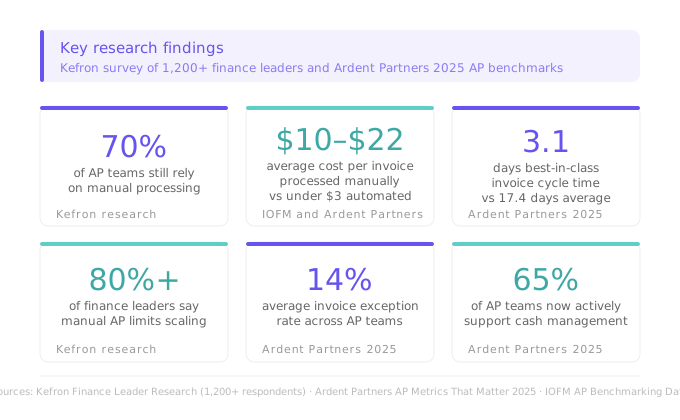
Kefron's research with more than 1,200 finance leaders reflects this reality. Most organizations understand how important AP is, yet many are still running manual or semi-automated processes with limited real-time visibility and growing operational pressure as invoice volumes increase.
That gap between importance and execution is exactly where value creation opportunities start to appear.
Working capital is the most immediate area where AP automation either creates or destroys value, and days payable outstanding (DPO) is the metric that captures it.
|
|
What is days payable outstanding (DPO)? DPO measures the average number of days a business takes to pay its suppliers. A higher DPO, achieved by paying suppliers at the latest permissible date within agreed terms, means the business holds onto cash for longer. A lower and erratic DPO, caused by disorganized AP processes, means cash leaves the business earlier than necessary and in an unpredictable way. |
Automated AP workflows improve DPO in two ways. First, they create visibility. Finance teams can see exactly when each invoice is due and make deliberate payment timing decisions rather than reactive ones. Second, they eliminate the approval delays that cause invoices to be paid late, not because the terms require it, but because the invoice was sitting in someone's inbox.
Beyond DPO, automated invoice processing directly improves cash flow forecasting accuracy. AP automation provides real-time data on approved invoices, outstanding liabilities, and scheduled payments. That data feeds cash flow models with live inputs rather than estimates. EY's research on cash flow forecasting found that companies with strong cash forecasting disciplines can achieve up to 90% quarterly accuracy against enterprise-level targets, a standard that is very difficult to reach when manual AP processes are feeding incomplete data into the model.
Kefron's research confirms the connection. Near-universal agreement among finance leaders surveyed identified approval speed as critical to cash flow. Small improvements in automated invoice approval speed can have an outsized impact on liquidity, particularly as invoice volumes scale.
One often-overlooked benefit of accounts payable automation is the ability to consistently capture early payment discounts. When AP processes are manual and slow, finance teams rarely have the visibility to identify and act on discount opportunities before the window closes.
Automated AP creates the right conditions for dynamic discounting, a program where suppliers offer a discount in exchange for early payment and the buying organization can selectively accept based on available cash. For PE-backed businesses with access to working capital facilities, dynamic discounting can generate returns that compare favorably with short-term investment alternatives while simultaneously strengthening supplier relationships.
Manual AP is expensive, and scale makes that cost more visible over time.
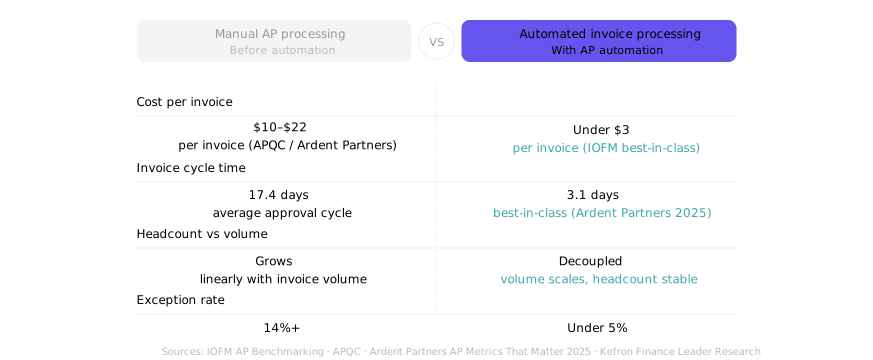
In the US, an AP clerk typically costs between $45,000 and $65,000 per year in salary and benefits. Manual invoice processing averages $9.87 per invoice once you account for data entry, approvals, and exception handling, a figure supported by Ardent Partners' AP Metrics That Matter in 2025. For a business processing 50,000 invoices per year, that works out to around half a million dollars in processing cost alone.
Ardent Partners' research also found that best-in-class AP organizations now process invoices in just 3.1 days on average compared to 17.4 days for those relying on manual workflows.
Kefron's research shows that 70% of AP teams still rely heavily on manual invoice processing, and more than 80% of finance leaders agree that manual AP makes it harder to scale. As explored in automating accounts payable for smarter finance operations, automation changes that equation in a meaningful way.
Manual processing vs. automated invoice processing
|
Manual Processing |
Automated Invoice Processing |
|
Manual data entry per invoice |
Automated OCR capture and extraction |
|
Slow, email-based approvals |
Configurable workflow routing |
|
High exception and error rates |
Three-way matching with automated validation |
|
Limited payment visibility |
Real-time reporting and audit trail |
|
Headcount grows with volume |
Volume scales without headcount growth |
For PE-backed businesses, the EBITDA implication is clear. When headcount no longer needs to grow proportionally with invoice volumes, processing cost as a percentage of revenue falls as the business scales. That margin improvement flows directly to EBITDA and, at exit, to valuation multiples.
Accounts payable is where financial leakage tends to happen quietly and where diligence teams look carefully during exit processes.
Highly manual AP processes increase the risk of duplicate invoice payments, approval workarounds, inconsistent documentation, and weak audit trails. Automated reporting and real-time invoice performance monitoring addresses all of these issues directly, giving finance teams a searchable, timestamped audit history without any manual effort.
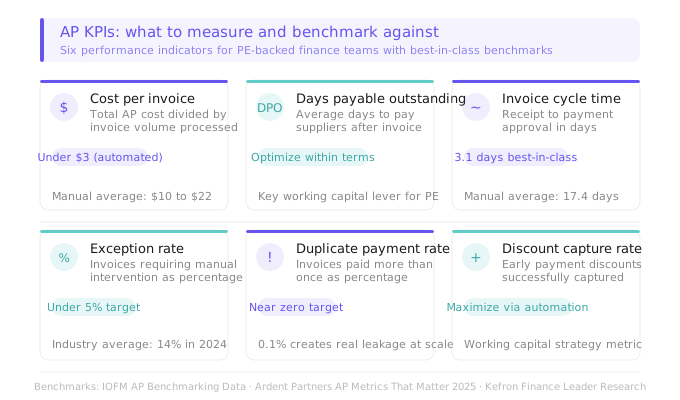
The most important accounts payable KPIs for PE-backed businesses, as benchmarked by the Institute of Finance and Management (IOFM), include the following. Kefron's AP analytics and reporting dashboards track all of these in real time without manual spreadsheets.
Three-way PO matching, which automatically reconciles purchase orders, goods receipts, and invoices before approving payment, prevents a significant proportion of both errors and fraud attempts without requiring manual review.
That level of control matters day to day, but it becomes even more important during audits, refinancing discussions, and exit planning. Buyers and their advisors will examine AP processes closely, and a well-documented automated AP function with clean audit trails signals operational maturity.
Ardent Partners reports that 75% of AP departments now use some form of AI, and 61% of finance professionals expect AI to have a transformational or significant impact on AP operations in 2025. For a CFO-level view of what this shift means in practice, see Kefron's analysis of how AI is transforming accounts payable.
AI-powered invoice capture is the process by which AP automation software automatically extracts structured data from supplier invoices without any manual keying. Using a combination of OCR and machine learning, the system identifies and pulls key fields including vendor name, invoice number, date, line items, amounts, and tax codes, regardless of whether the invoice arrives as a PDF, scanned document, email attachment, or electronic file through a supplier portal.
What makes AI capture different from older OCR-only systems is that it learns. Accuracy improves over time as the system processes more invoices from each supplier and recognizes their specific layouts. Kefron's AI invoice processing combines machine learning with a team of expert invoice engineers to target 99% extraction accuracy on the first pass, so AP teams spend their time on genuine exceptions rather than correcting routine data entry errors. For a business processing 10,000 invoices a month, that difference eliminates the manual correction of roughly 900 invoices every single month.
Intelligent three-way matching is the automated comparison of a supplier invoice against the original purchase order (PO) and the goods receipt note (GRN), verifying that what was ordered, received, and billed all align before any payment is approved.
In a manual environment this is one of the most time-consuming AP tasks. AI runs it automatically on every invoice, resolves common variance patterns within pre-configured tolerance rules, and only sends genuine discrepancies to a human for review. The result is that AP teams go from touching nearly every invoice to reviewing only the small percentage with real issues. Kefron's three-way PO matching supports both two-way and three-way matching with configurable tolerance rules, exception workflows, and direct ERP integration so matched transactions export automatically without anyone rekeying data.
AI-powered anomaly detection automatically identifies invoices that deviate from established patterns before they are approved for payment. The system compares every incoming invoice against historical data across multiple dimensions simultaneously, including vendor name, invoice number, amounts, bank details, and line-item descriptions, flagging anything outside expected parameters for human review.
In practice this catches three things that manual processes miss: duplicate invoices including near-duplicates where only the invoice number has changed, vendor master fraud where a supplier's bank details have been updated to redirect payments, and invoices from unfamiliar vendors or for unusual amounts. Ardent Partners reports that organizations with automated duplicate detection catch up to 95% of duplicates before payment. Within Kefron AP, flagged exceptions surface directly in the AP analytics and reporting dashboard, giving finance leaders a real-time view of exception trends, recurring problem suppliers, and the dollar value of prevented duplicate payments.
AI-powered approval routing intelligence automatically directs each invoice to the correct approver based on configurable business rules combined with machine learning from historical approval patterns. Rather than relying on static routing tables that someone has to manually maintain, the system learns who approves invoices from a given supplier, in a given cost center, above a given value threshold, and routes accordingly.
In a manual environment invoices get stuck because they land with the wrong person, the approver is out of office, or the request gets buried. AI routing solves all three: right person first time, automatic escalation if no action is taken, and structured notifications with full invoice context rather than forwarded email attachments. Kefron's automated invoice approvals supports multi-level approval chains, smart routing by department, vendor, value and entity, automated reminders, and unlimited users without needing to restructure the existing AP workflow. Businesses that implement this typically see approval cycle times fall from 17.4 days to under 4 days, with best-in-class organizations reaching 3.1 days according to Ardent Partners 2025.
The invoice approval workflow is where most AP processes break down. Invoices arrive, get forwarded to approvers by email, sit in inboxes, generate chaser requests, and eventually get approved, often days or weeks after the invoice date.
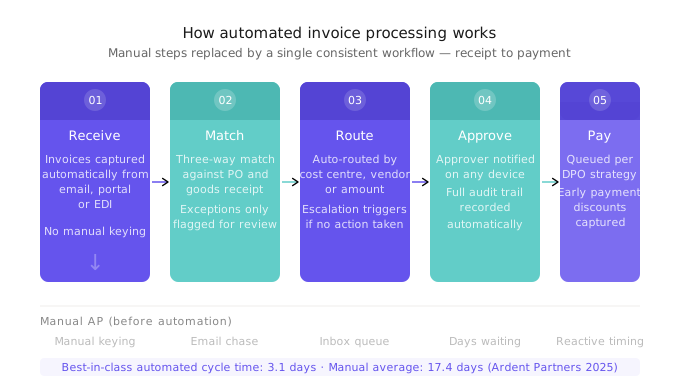
The mechanism by which AP automation improves this is direct.
Businesses that move from manual to automated invoice approval workflows typically see approval cycle times fall from days to hours, which is a direct and measurable improvement in working capital management.
Here is the practical irony. Improving AP automation is often one of the lowest-risk, fastest-payback initiatives available to a PE-backed finance team. It does not require a new business model, a new product, or a major go-to-market change. Kefron's guide on improving accounts payable workflow walks through where most teams start and what the biggest gains typically are.
As McKinsey's research on PE value creation notes, the most controllable source of new value in today's environment is a company's own operations. With higher interest rates and more demanding exit conditions, operational improvements that directly affect cash and margin are increasingly where returns are actually made. AP automation sits squarely in that category.
In PE-backed environments where growth and acquisitions drive invoice volumes up quickly, the return compounds faster than most teams expect. A business processing 30,000 invoices per year that grows to 80,000 through acquisition faces a processing cost challenge almost immediately unless automation is already in place.
Yet AP automation is still too often treated as something to cope with rather than something to optimize. Finance teams are given the task of managing the function rather than transforming it. And sponsors rarely ask about AP in portfolio reviews because the connection between AP maturity and value creation has not yet become part of standard operating practice.
That is starting to change, and the businesses that move first have a real advantage.
Accounts payable automation is software that automatically captures, validates, matches, and routes supplier invoices through approval and payment workflows. It replaces manual data entry and email-based approval chains with a structured, auditable process that reduces cost, accelerates approvals, and improves financial controls. See Kefron AP for a full overview of how the solution works.
AP automation improves cash flow forecasting by providing real-time visibility into approved invoices, outstanding liabilities, and scheduled payments. EY's research identifies real-time data connectivity as the primary driver of cash forecasting accuracy, with best-practice companies reaching up to 90% quarterly accuracy. Kefron's finance analytics dashboards surface this data automatically across the AP function.
AP automation improves DPO by creating visibility into payment timing and eliminating the approval delays that cause unintentional early payment. When finance teams can see every invoice in the pipeline and its due date, payment timing becomes a deliberate working capital decision. For a detailed explanation of how DPO is calculated and benchmarked, see J.P. Morgan's guide to DPO and cash flow.
PE-backed businesses benefit from AP automation for three core reasons. First, it protects working capital through better DPO management and early payment discount capture. Second, it improves EBITDA by reducing the cost per invoice and preventing headcount from growing alongside invoice volumes. Third, it strengthens controls and audit readiness, both of which directly affect exit process quality and valuation confidence.
Automating accounts payable typically involves four steps: selecting an AP automation solution that integrates with your existing ERP or accounting system, configuring invoice capture to handle your supplier formats, setting up approval workflow rules by cost center, amount, and vendor, and establishing payment run scheduling in line with your DPO strategy. Most implementations can be completed in 8 to 16 weeks depending on complexity. Kefron's AP automation start your journey guide provides a full evaluation framework.
Invoice processing automation begins with automated capture, using OCR invoice processing and AI to extract invoice data without manual keying. The system then validates the data against purchase orders and goods receipts through three-way PO matching, routes the invoice for approval based on pre-set rules, and records the approved invoice for payment.
According to IOFM's AP practitioner benchmarks, a skilled AP clerk processing invoices manually can typically handle between 2,000 and 5,000 invoices per month. With AP automation handling data capture and routine matching, the same person can oversee ten to twenty times that volume while focusing on exceptions, supplier queries, and controls rather than data entry.
The most important AP KPIs are cost per invoice (under with automation), days payable outstanding, invoice cycle time (3.1 days best-in-class), exception rate (14% industry average), duplicate payment rate, and early payment discount capture rate. Kefron's AP reporting and analytics dashboard tracks all six automatically.
AI-powered AP systems detect duplicate invoices by comparing incoming invoices against historical records across multiple dimensions at once, including invoice number, vendor, amount, date, and line-item detail. Ardent Partners reports that AI-driven anomaly detection is now one of the primary use cases driving AP automation adoption.
If most finance leaders agree that AP influences cash flow, scalability, and risk, the conversation should not stay theoretical.
The practical question is a simple one. Is accounts payable automation actively supporting your value creation plan, or is it quietly undermining it?
Research exploring how PE-backed and scaling organizations are rethinking AP as a strategic lever rather than a back-office function is available in our detailed insights guide. It covers process maturity, automation levels, operational challenges, and where finance leaders are focusing next as they scale.
Download the full AP Automation Insights Guide for PE-backed businesses