Quick answer: A compliant IT asset disposal (ITAD) process must include certified data destruction with a certificate per device, a documented chain of custody from collection to final outcome, recognised third-party accreditation (such as ADISA or R2v3), and full compliance with GDPR and the WEEE Directive. If your current provider or donation route can't produce evidence of all four, your organisation carries the compliance risk — not them.
Every laptop, phone, or server that leaves your office carries two things: hardware value and data risk. The hardware is easy to account for. The data risk is where most businesses — and most well-meaning donation schemes — fall short. This checklist breaks down exactly what to verify before any device leaves your premises.
Why an IT Asset Disposal Checklist Matters
Improper IT asset disposal isn't a hypothetical risk. It's one of the most common — and most preventable — causes of data exposure:
- 68% of organisations have experienced a data breach caused by improperly disposed hardware (Kaspersky, 2023).
- GDPR fines for insecure IT asset disposal can reach €20 million or 4% of global annual turnover, whichever is higher.
- 50 million tonnes of e-waste are produced globally each year, making IT equipment the world's fastest-growing waste stream.
Responsibility for a data breach doesn't transfer just because a device left your building. If your name is on the asset register, you need to be able to prove what happened to it next.
The IT Asset Disposal Compliance Checklist
Use this checklist to assess any ITAD provider, recycler, or donation partner before handing over retired equipment.
1. Certified Data Destruction
- Is every drive wiped or physically destroyed to a documented, internationally recognised standard (e.g. NIST 800-88)?
- Is data erasure performed using accredited software, such as a Blancco-certified partner?
- Do you receive a certificate of destruction for every individual device — not a generic statement covering a batch?
- Is destruction carried out to BS EN 15713, the standard for secure destruction of confidential material?
2. Chain of Custody
- Can the provider trace a specific device from collection at your office to its final outcome (resale, recycling, or destruction)?
- Are handovers logged at every stage, with no unaccounted gaps?
- Is on-site collection carried out by vetted staff, ideally to a recognised standard such as BS 7858 security screening?
- If drives are shredded on-site, is the shredding fleet independently certified (for example, by a national protective security authority)?
3. Recognised Third-Party Accreditation
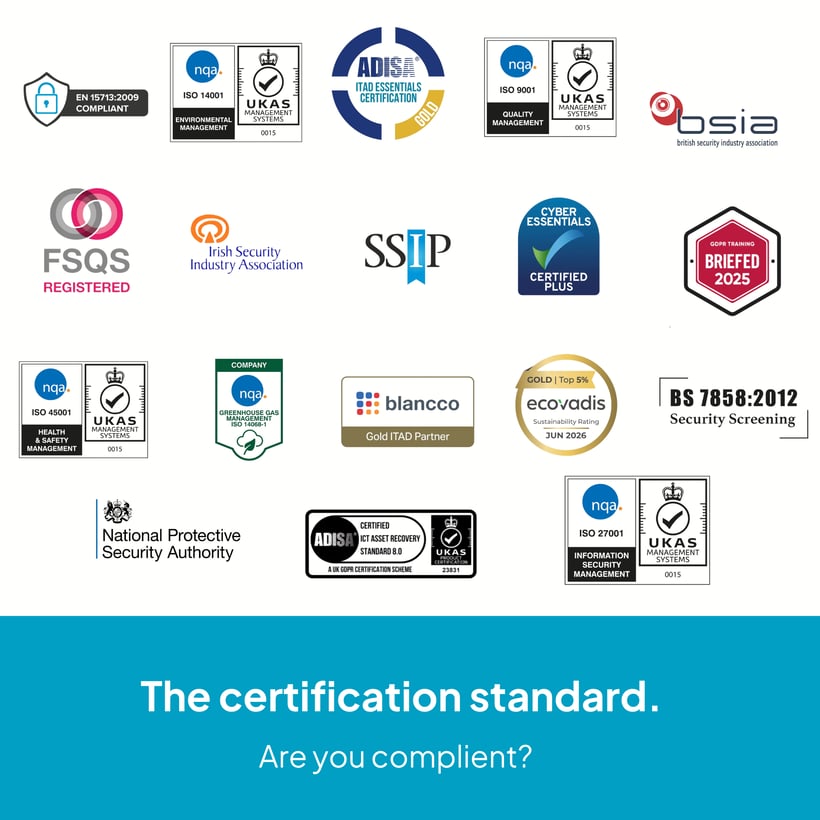
- Is the provider certified to ADISA (Asset Disposal & Information Security Alliance) — ideally at Distinction level, the highest tier?
- Do they hold R2v3 certification, the global standard for responsible electronics recycling?
- Are they certified to Cyber Essentials Plus for information security practices?
- Is staff GDPR training documented and renewed annually, not a one-off induction?
Self-declared compliance isn't the same as independently audited compliance. Ask for certificate numbers and audit dates, not just a logo on a website.
4. Environmental & Regulatory Compliance
- Is the provider a registered Approved Treatment Facility (AATF) or equivalent under WEEE regulations?
- Do they hold valid waste carrier and waste collection permits for your jurisdiction?
- Are their facilities audited and certified carbon neutral (e.g. to PAS 2060), if sustainability reporting matters to your ESG targets?
- Is e-waste handled in line with the WEEE Directive and relevant hazardous waste regulations?
5. Reporting & Auditability
- Will you receive an asset-level disposal report, not just a summary invoice?
- Can this report be produced on demand if a regulator or auditor asks for it?
- Does the provider retain records for the length of time your compliance policy requires?
Certified Disposal vs. Uncertified Donation: What's the Real Difference?
Donating retired IT equipment to a charity or social enterprise can be a genuinely good outcome — reuse is better than landfill, and many organisations do valuable work extending a device's life. But donation and data destruction are two separate problems, and most donation routes are built to solve only the first one.
| |
Certified ITAD Provider |
Typical Donation Route |
| Data destruction certificate per device |
Yes |
Rarely |
| Independently audited (ADISA / R2v3) |
Yes |
Rarely |
| Documented chain of custody |
Yes |
Often informal |
| GDPR-compliant erasure process |
Yes |
Not guaranteed |
| Audit-ready reporting |
Yes |
Rarely |
| Device gets a second life |
Yes, where eligible |
Yes |
A device can be reused and be provably, certifiably clean of data — the two aren't a trade-off. But that's only true if the process behind it is built to prove it, in writing.
Frequently Asked Questions
Is IT asset disposal legally required to be certified in Ireland and the UK? There's no single law that mandates a specific certification. However, GDPR requires organisations to ensure personal data is securely and verifiably destroyed, and the WEEE Directive governs how electronic equipment must be treated at end of life. In practice, working with a certified provider is the only reliable way to demonstrate compliance with both.
What happens if a data breach is traced back to a donated or improperly disposed device? Liability generally stays with the organisation that originally held the data, regardless of who physically disposed of the device. Without a certificate of destruction and a chain of custody, there's no way to prove the data was properly handled — which puts the full weight of a GDPR investigation back on your business.
What's the difference between ADISA and R2v3 certification? ADISA (Asset Disposal & Information Security Alliance) focuses specifically on data security throughout the disposal process, with audited standards up to Distinction level. R2v3 (Responsible Recycling) is a global standard focused on environmentally and socially responsible handling of electronics, including data security requirements. Providers certified to both cover data security and environmental compliance.
Can retired IT equipment be resold as well as securely wiped? Yes. Eligible devices can be data-sanitised to a certified standard, refurbished, and resold through trusted channels — recovering up to 30% of original value while remaining fully compliant. Certified data destruction and value recovery aren't mutually exclusive.
How long should disposal records be kept? This depends on your organisation's data retention policy, but most businesses retain destruction certificates and chain-of-custody records for a minimum of 6–7 years to align with standard audit and regulatory review periods.
What documents should I ask for before handing over old devices? At minimum: a certificate of data destruction per device (or per batch with serial numbers listed), proof of the provider's current accreditations (ADISA, R2v3, Cyber Essentials Plus), and a final disposal report showing the outcome of each asset (resold, recycled, or destroyed).
The Bottom Line
A compliant IT asset disposal process isn't complicated — but it does need to be provable. If your current disposal or donation route can't produce a certificate of destruction, a chain of custody, and third-party accreditation on request, that's a gap worth closing before your next refresh cycle.
Speak to Our ITAD Team →