Key Takeaways
- Compliance is the minimum — "we're compliant" tells you nothing about how robust or auditable the process actually is
- Independent certification is proof; everything else is a claim — look for ISO 27001, Cyber Essentials Plus, and Blancco Gold Partner status
- A factory reset doesn't erase data — certified erasure or physical destruction is non-negotiable
- Chain-of-custody starts the moment assets leave your building — GPS tracking and serial number logging close the accountability gap
- Compliance and value recovery aren't in conflict — a well-run ITAD process delivers both
- The right question isn't "are they compliant?" — it's "can they prove it?"
When it comes to IT asset disposal, compliance is non-negotiable.
Every organisation has a responsibility to ensure retired laptops, servers, mobile devices, and storage media are handled securely, disposed of responsibly, and processed in accordance with regulatory requirements. Data must be destroyed. Equipment must be tracked. Documentation must be available.
Any credible IT asset disposition (ITAD) provider will tell you they meet these requirements.
The problem is that compliance alone doesn't tell you very much.
It doesn't tell you whether the process has been independently verified. It doesn't tell you how robust the provider's security controls are. It doesn't tell you whether the documentation would withstand an audit, regulatory investigation, or cybersecurity review.
And it certainly doesn't tell you whether your organisation is recovering the value contained within its retired IT assets.
The reality is that there is a significant difference between a provider that claims to follow best practices and one that can demonstrate it through recognised certifications, documented processes, and independent verification.
Why Compliance Alone Isn't Enough
Many organisations evaluate IT disposal providers using a simple checklist:
- Is data destroyed?
- Is equipment recycled?
- Do we receive a certificate?
While these are important questions, they only address the minimum acceptable standard.
Modern organisations face increasing scrutiny around:
- GDPR compliance
- Information security
- ESG reporting
- Supply chain governance
- Environmental responsibility
- Audit readiness
In this environment, simply being "compliant" is no longer enough.
The quality, transparency, and credibility of the process matter just as much as the outcome.
When an auditor, regulator, customer, or board member asks for evidence, organisations need more than assurances. They need independently verified proof that their IT assets have been handled securely and responsibly.
What ITAD Certifications Actually Mean
There is a significant difference between a provider saying their process is secure and a provider proving it through independent assessment.
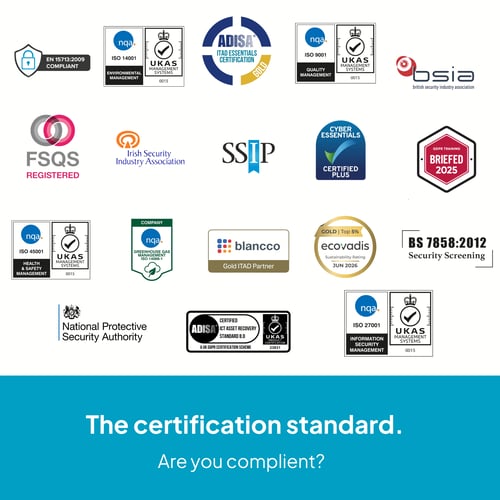
Recognised certifications demonstrate that policies, procedures, controls, and operational practices have been audited against internationally accepted standards such as information security management frameworks like ISO 27001.
These certifications provide assurance that security and compliance are embedded into the process rather than simply claimed in marketing materials.
For organisations handling customer data, employee records, financial information, intellectual property, or commercially sensitive data, this distinction matters.
Key Certifications to Look For
| Certification |
What It Demonstrates |
| ISO 27001 |
Information Security Management Systems |
| ISO 14001 |
Environmental Management Systems |
| Cyber Essentials Plus |
Independently verified cybersecurity controls |
| BS 7858 |
Security screening and vetting of personnel |
| Blancco Gold Partner Status |
Certified and independently verified data erasure |
| WEEE Compliance |
Responsible electronic waste recycling and disposal |
At Kefron, these certifications provide independent verification that every stage of the ITAD process has been assessed and audited against recognised standards.
They are not marketing badges. They are evidence.
Why Independent Verification Matters
Many providers claim secure processes. Fewer can demonstrate that those processes have been tested by external auditors.
Independent certification provides confidence that:
- Security procedures are documented and followed
- Data destruction methods meet recognised standards
- Environmental obligations are being met
- Staff handling sensitive equipment are appropriately screened
- Controls are regularly reviewed and maintained
This is particularly important for organisations operating in regulated sectors such as financial services, healthcare, government, education, and professional services.
The greater the compliance burden, the greater the need for credible evidence.
What a Secure IT Asset Disposal Process Should Look Like
Certification is important.
Transparency is equally important.
A process you cannot clearly see is a process you cannot fully evidence.
The best ITAD providers operate fully documented, end-to-end processes that create accountability at every stage.
A secure process should include:
- Secure asset collection
- Chain-of-custody tracking
- Asset inventory and serial number recording
- Certified data destruction
- Asset testing and assessment
- Remarketing or recycling
- Final reporting and certification
Every step should be visible, documented, and auditable.
Secure Collection and Asset Tracking
The disposal process begins long before data destruction takes place.
Transport and chain-of-custody controls play a critical role in maintaining security.
Organisations should look for providers that offer:
- GPS-tracked collection vehicles
- Secure transportation methods
- Asset inventory management
- Full serial number tracking
- Controlled handling procedures
Without these controls, there may be gaps in accountability between collection and processing.
At Kefron, assets are collected using GPS-tracked vehicles and recorded throughout the process to ensure complete visibility from collection to final disposition.
Certified Data Destruction: Why It Matters
Data destruction is often the most important aspect of IT asset disposal.
Retired devices frequently contain:
- Customer information
- Employee records
- Financial data
- Emails and communications
- Contracts
- Intellectual property
- Commercially sensitive documents
Many organisations still assume that formatting a drive or performing a factory reset permanently removes data.
It does not.
Professional ITAD providers use certified software erasure or physical destruction methods that meet recognised security standards.
Common Data Destruction Methods
| Method |
Typical Use Case |
| Certified Software Erasure |
Reusable devices intended for resale |
| Physical Drive Shredding |
End-of-life storage devices |
| Degaussing |
Magnetic media destruction |
| Physical Destruction |
High-security environments |
As a Blancco Gold Partner, Kefron uses independently verified data erasure technology that provides detailed audit trails and reporting for every device processed.
Environmental Responsibility and WEEE Compliance
Secure disposal is only part of the story.
Organisations are increasingly expected to demonstrate environmental responsibility throughout the technology lifecycle.
Electronic waste remains one of the fastest-growing waste streams globally, making responsible disposal and recycling more important than ever.
A modern IT asset disposal programme should prioritise:
- Refurbishment where possible
- Equipment reuse
- Component recovery
- Responsible recycling
- WEEE-compliant processing
- Minimal landfill contribution
At Kefron, less than 1% of processed material goes to landfill, helping organisations meet both compliance and sustainability objectives.
Compliance and Value Recovery Work Together
Many organisations assume they must choose between secure disposal and financial recovery.
In reality, the strongest ITAD programmes achieve both.
Because every asset is catalogued, assessed, and processed individually, opportunities for resale can be identified before equipment is recycled.
Assets with resale potential can be:
- Refurbished
- Tested
- Certified
- Remarketed through approved channels
Assets that cannot be resold can still generate value through component harvesting and responsible recycling.
Compliance-Only Disposal vs Certified Value-Recovery ITAD
| Compliance-Only Disposal |
Certified Value-Recovery ITAD |
| Basic disposal process |
End-to-end asset lifecycle management |
| Data destruction |
Certified and auditable data destruction |
| Limited reporting |
Detailed asset-level reporting |
| Focus on risk reduction |
Risk reduction plus value recovery |
| Assets often recycled immediately |
Assets assessed for resale potential first |
| Disposal viewed as a cost |
Disposal contributes financial return |
Compliance and value recovery are not competing priorities.
They are part of the same well-managed process.
What Documentation Should You Receive?
A professional IT asset disposal provider should supply documentation that supports:
- GDPR compliance
- Internal audits
- External audits
- Cybersecurity reviews
- ESG reporting
- Asset management requirements
Typical documentation should include:
| Document |
Purpose |
| Certificate of Data Destruction |
Proof of secure erasure or destruction |
| Asset Inventory Report |
Full device-level tracking |
| Serial Number Report |
Evidence of processed assets |
| Recycling Certificate |
Confirmation of responsible recycling |
| Environmental Reporting |
ESG and sustainability metrics |
| Value Recovery Report |
Visibility of recovered asset value |
The stronger the documentation, the easier it becomes to demonstrate compliance to auditors, regulators, customers, and internal stakeholders.
The Question Compliance Alone Doesn't Answer
Your current provider may be compliant.
That is the minimum expectation.
The more useful question is whether their process is:
- Independently certified
- Fully transparent
- Completely auditable
- Secure from collection to final disposition
- Structured to maximise value recovery
Those factors are what transform IT asset disposal from a necessary operational task into a managed, evidenced, and financially beneficial process.
At Kefron, every stage of the ITAD process is independently certified, fully documented, and designed to protect both your data and your organisation's interests. Assets are securely collected, tracked, destroyed or remarketed through certified processes, and supported by comprehensive reporting throughout.
Because compliance is essential.
But compliance alone is only the starting point.