
8 Things UK Finance Teams Should Know About AP Automation
Choosing accounts payable automation software is more than a technology decision. For UK finance...
Last updated: 6 November 2026
E-invoicing in the UK becomes mandatory on 1 April 2029. From that date, UK VAT-registered businesses and relevant public bodies must issue and receive domestic VAT invoices as structured e-invoices over the Peppol network. PDF and paper invoices won't be accepted for anything in scope. Final rules are due in April 2028, leaving 12 months for testing and onboarding before the deadline.
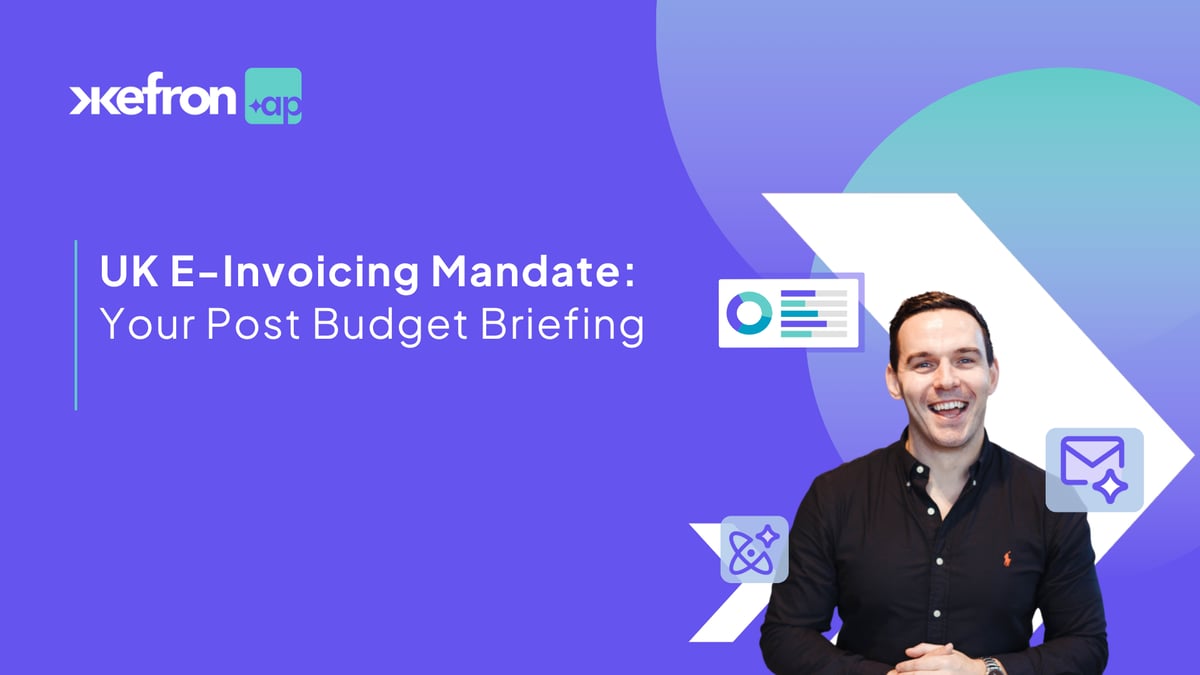
The government confirmed its e-invoicing implementation roadmap in the Budget on 28 October. A week later, James Kearns, who leads e-invoicing at Kefron AP, ran a post-Budget briefing for finance teams. James has spent the last two years helping organisations meet e-invoicing requirements across multiple countries. This article sets out what he covered: what's confirmed, how Peppol e-invoicing works, what it means for your accounts payable process, and what to do now and what to hold off on.
Watch the full 30-minute briefing above. Quotes in this article are lightly edited for readability.
Yes. UK e-invoicing will be mandatory from 1 April 2029. It applies to UK VAT-registered businesses and relevant public bodies, including local councils. There are two obligations: issuing e-invoices to customers (your accounts receivable process) and receiving e-invoices from suppliers (your accounts payable process).
The Finance Bill still has to pass to change the law, and the technical detail will be settled through consultation in 2027. But the direction is set, and the roadmap is published.
| Date | Milestone |
|---|---|
| 28 October (Budget) | Implementation roadmap published, Peppol confirmed |
| Spring 2027 | Technical design and consultation: invoice standards, connectivity and data flows |
| April 2028 | Final rules issued, including any exemptions or phasing |
| April 2028 to April 2029 | Implementation, testing and onboarding |
| 1 April 2029 | Mandate deadline: in-scope businesses must issue and receive e-invoices via Peppol |
The April 2028 milestone is the one to plan around. In James's words, it "gives all of us 12 months and a clear view of the rules". There's no phased implementation planned at the moment. Some countries phase mandates by turnover or company size. France, for example, started with its largest organisations and gave smaller businesses more time. The UK may still announce something similar, but there's no detail yet.
| Area | What's confirmed |
|---|---|
| Who it affects | UK VAT-registered businesses and relevant public bodies |
| Included | Domestic B2B VAT invoices and relevant B2G VAT invoices |
| Obligation | Issuing (AR) and receiving (AP) |
| Excluded | B2C where no VAT invoice is required. Cross-border invoices are not currently included |
| Network | Peppol, decentralised four-corner model |
| Authority | HMRC will act as the UK Peppol authority |
| Format | Not yet confirmed. Expected to be XML, very likely Peppol BIS |
| Real-time reporting | Not part of the mandate. HMRC is running a separate consultation |
| EDI | Expected to coexist, but EDI transactions will need to be compliant |
Expect more exemptions. "In my experience, I would anticipate that there will be more exemptions to follow," James said. In other countries, some transactions sit outside scope based on value, for example invoices below €250. Nothing like that has been announced for the UK, and James was clear it's his own view, but he expects more detail during the 2027 consultation.
If you trade in high volumes over EDI, for example in retail, hospitality or manufacturing, EDI should continue alongside Peppol. But those transactions will still need to meet the mandate's requirements.
The UK isn't doing anything unusual here. As James put it, whether it's the UK, EU member states or countries outside the EU, there are usually four objectives behind an e-invoicing mandate:
Peppol is an international network for exchanging structured e-invoices between certified access points. It's how the UK mandate will work, and James called it the best news of the Budget announcement:
"The good news, and it should genuinely be good news for everyone, is the UK government have confirmed the selection of the Peppol network to support a decentralised e-invoicing mandate."
Decentralised means you don't connect to an HMRC portal. You connect to the network through a third party, an access point, and the network handles delivery. Compare that with the clearance mandates in France and Poland, where businesses have to connect to the tax authority's own portal. Peppol has been running for around two decades and is already used for e-invoicing in countries like Belgium. As James put it, "it's a well-worn path in terms of connectivity for different governments."
The four-corner model describes the four parties involved in every e-invoice:
The Peppol network sits in the middle. It identifies the receiver and routes the invoice between access points. James described it as "the glue that holds the whole process together." When you issue a sales invoice from your ERP, you're corner one. When a supplier sends you an invoice, it travels from their access point, across the network, to your access point and into your system. You're corner four.
A Peppol access point is a certified service provider that connects your business to the Peppol network and sends and receives e-invoices on your behalf. You don't need to become one. When asked in the briefing, James said:
"You absolutely can, but I would imagine that's not part of your day-to-day business operation. So the answer is no. You definitely don't need to do it."
Most businesses will use an access point provider: their ERP vendor, their AP automation provider, or a specialist. Kefron acts as the Peppol access point for Kefron AP customers.
Your access point provider registers you on the Peppol network and gives you a Peppol ID, the identifier suppliers and customers use to send e-invoices to you. They'll need your company registration number and VAT number for each legal entity. Once registered, you're published on the Peppol directory so trading partners can find you.
Check now whether you already have an active Peppol participant ID, for example from operations in another country, and who manages it. As James warned, if you change provider later, "you will have to deregister and then re-register."
This was the point James stressed most. E-invoicing changes how invoices arrive. It doesn't change what you have to do with them.
"Just because the government are introducing mandatory e-invoicing and the file formats will change, the associated AP process doesn't. The purchase order matching, the non-PO coding, the approval piece, all still needs to be carried out whether it's an e-invoice or not."
He called this "one common misconception": because e-invoicing is system-to-system data exchange, people assume the rest takes care of itself. It doesn't. Exceptions, discrepancies and tolerances still need handling. Invoices still need three-way matching, approval workflows and posting to your ERP.
You'll also keep receiving PDF and paper invoices. Cross-border suppliers won't have to send you e-invoices ("they may, but they won't need to"), and anything exempt will still come in the old way. Most AP teams will run a mixed intake after 2029: e-invoices from domestic suppliers, and PDF or paper from everyone else. Your invoice processing software needs to handle both in one workflow.
James acknowledged that the mandate is causing concern for many finance teams: "I appreciate that this can be stressful. There's lots of different information. There's lots of different providers."
For Kefron AP customers, Kefron will act as your Peppol access point, the same way we already do for customers operating in Belgium. We manage the connectivity and the registration, and give you your Peppol ID. Onboarding works like this:
When an e-invoice arrives, Kefron AP converts the XML into a readable PDF, so AI data extraction and line-level matching work exactly as they do today. UK PO and non-PO e-invoices go into their own data banks alongside your other entities and invoice types, then through your normal automated invoice processing workflow and into your ERP once matched or approved. Both the PDF and the original XML are stored in the Document Centre for archiving.
"Hopefully not a major change other than the front end of the process."
Kefron also intends to support customers on the AR side through the same access point, as we already do in Belgium. Details will follow. See our e-invoicing solution for more.
James's main message on readiness was about timing. The technical consultation is in spring 2027 and the final rules land in April 2028, so details will change between now and then.
"It's important to just make sure that we're ready, but we're not getting too ahead of ourselves at this point."
Go through your vendor and customer master data. Document which suppliers and customers are domestic B2B, which send cross-border invoices, and which may be exempt. Public bodies should do the same for B2G. James suggests scheduling the detailed data review for around April 2028: "I don't anticipate doing that too far ahead of that time, because it'll still give you a year to get ready."
Work out your inbound AP volumes from domestic B2B suppliers and your outbound AR volumes, by entity and invoice type. It's also a good moment to benchmark your cost per invoice, so you can measure what changes.
Start with your ERP provider. James's view: "Any of the modern ERP systems operating in the UK will definitely need to have some form of offering in terms of access points." Ask what they offer for AP and AR Peppol connectivity, whether they've done it before, and whether you'll need upgrades or new integrations. If you're on a legacy ERP or an older version, expect the conversation to go there: "This may be a turning point for the vendor that you're working with to encourage you to upgrade."
Kefron AP integrates with the main ERPs used by UK finance teams, including NetSuite, Sage, Dynamics 365 Business Central and Oracle Fusion.
Validate your legal entities, VAT numbers and registration details. Clean up entities that exist but you no longer use. Check whether you already have an active Peppol participant ID and who manages that registration.
Closer to the deadline, pick suppliers and customers you have long-standing relationships with and agree to test together. James called this the step teams most often underestimate (more below).
Kefron has deployed e-invoicing for customers in more than 15 countries. These are the practical lessons James shared from those projects. (For more on how finance teams are approaching e-invoicing, see highlights from the FISCAL EMPOWER partner panel.)
Timelines change. Poland postponed its mandate by two years. Belgium, which recently went live, introduced a grace period. That doesn't mean the UK date will move, but it shapes how much to do and when: "Plan for the UK deadline, but I would encourage you not to do too much work too early. If there's a new exemption announced or a different technical specification, you've done a lot of work and then the goalposts change."
Phased rollouts are common. France and Poland phased their rollouts by business size, based on revenue and employee count. Germany staggered its obligations: businesses had to be able to receive e-invoices from 2025 but don't need to issue them until 2027. James called it "a light mandate". The UK hasn't announced phasing, but it could.
Adoption is staggered. "I think everybody probably thinks 1 April 2029, our e-invoice volume is going to explode. In my experience, trading partners reach readiness at different times." Smaller and mid-market businesses without the resources of large enterprises often take longer. Volumes will build over time.
Test with real trading partners. Because adoption is staggered, finding partners ready to test when you are is harder than it sounds. James saw this in Belgium, Germany and France. His advice is to build "almost like a user group of different businesses that you can test with" from your existing suppliers and customers. Where teams had no real test partners, user acceptance testing ran entirely on dummy data, and "testing with dummy data is great. It's part of the process, but it's not a substitute for the real thing."
Treat receiving and issuing as two workstreams. Receiving (AP) and issuing (AR) each have their own nuances. Give each one an owner. One person can own both, but the goal is to make sure both are tested at the same time.
Compliance doesn't equal automation. Structured data exchange through Peppol doesn't replace PO matching, cost allocation, approvals, exception handling or ERP posting. Being compliant on 1 April 2029 is the minimum. The efficiency gains come from automating what happens after the invoice arrives, which is where touchless processing rates are won or lost. If you're reviewing your finance systems ahead of the mandate, our CFO tech stack guide is a useful starting point.
Want to see how Kefron AP handles e-invoices alongside PDF and paper? Book a demo.
1 April 2029. From that date, UK VAT-registered businesses and relevant public bodies must issue and receive domestic B2B and relevant B2G VAT invoices as e-invoices via the Peppol network. Final rules are due in April 2028.
Peppol e-invoicing is the exchange of structured electronic invoices between businesses through the Peppol network, using certified access points. The UK has chosen Peppol for its mandate, and HMRC will act as the UK Peppol authority.
It's how invoices travel on Peppol. The sender (corner one) sends the invoice through its access point (corner two), which delivers it to the receiver's access point (corner three), which passes it to the receiver (corner four).
Yes, but only for invoices outside the mandate, such as cross-border invoices and any exempt transactions. In James's words: "Anything that's stipulated under the mandate will need to be via e-invoice, not PDF. That won't be acceptable."
No. Most businesses will use an access point provider. Kefron acts as the Peppol access point for Kefron AP customers.
Through your access point provider. They'll need your company registration and VAT number for each legal entity, then register you on the Peppol network and publish you on the Peppol directory.
Not at the moment. No phasing by company size has been announced, though that could change when the final rules are issued in April 2028.
James recommends three things: remove duplicate suppliers across entities; remove inactive vendors you haven't worked with in the last 12 months; and align each supplier's and customer's legal name, VAT number, company registration and trading name. Legal and trading names are often different, and getting them aligned matters for Peppol.
No. E-invoicing standardises how invoice data is exchanged. Matching, coding, approvals and exception handling still have to happen. Kefron AP converts incoming e-invoices and runs them through the same automated workflow as your other invoices.