
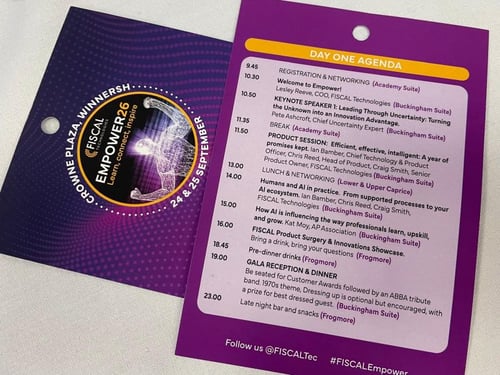
Putting Finance Transformation Into Practice: Highlights From the FISCAL EMPOWER Partner Panel
On Friday 25th September, the FISCAL EMPOWER partner panel brought together leading voices from...
AI-powered accounts payable automation is reshaping how finance teams operate, turning AP from a back-office burden into a strategic business driver. Kefron AP, an Irish fintech, is at the forefront of this shift, helping organisations eliminate manual invoice processing, improve financial visibility, and scale without adding headcount. In this article, we explore how Kefron AP works, what the evolving role of the CFO looks like, and why now is the time to act.
Accounts payable automation is technology that automatically captures, validates, routes, and processes supplier invoices — replacing manual data entry with AI-driven workflows. Rather than having finance staff key in invoice data line by line, AP automation extracts the information directly from the invoice, matches it against purchase orders, and moves it through the approval process automatically.
The result: faster processing, fewer errors, reduced costs, and real-time visibility over what a business owes and when.
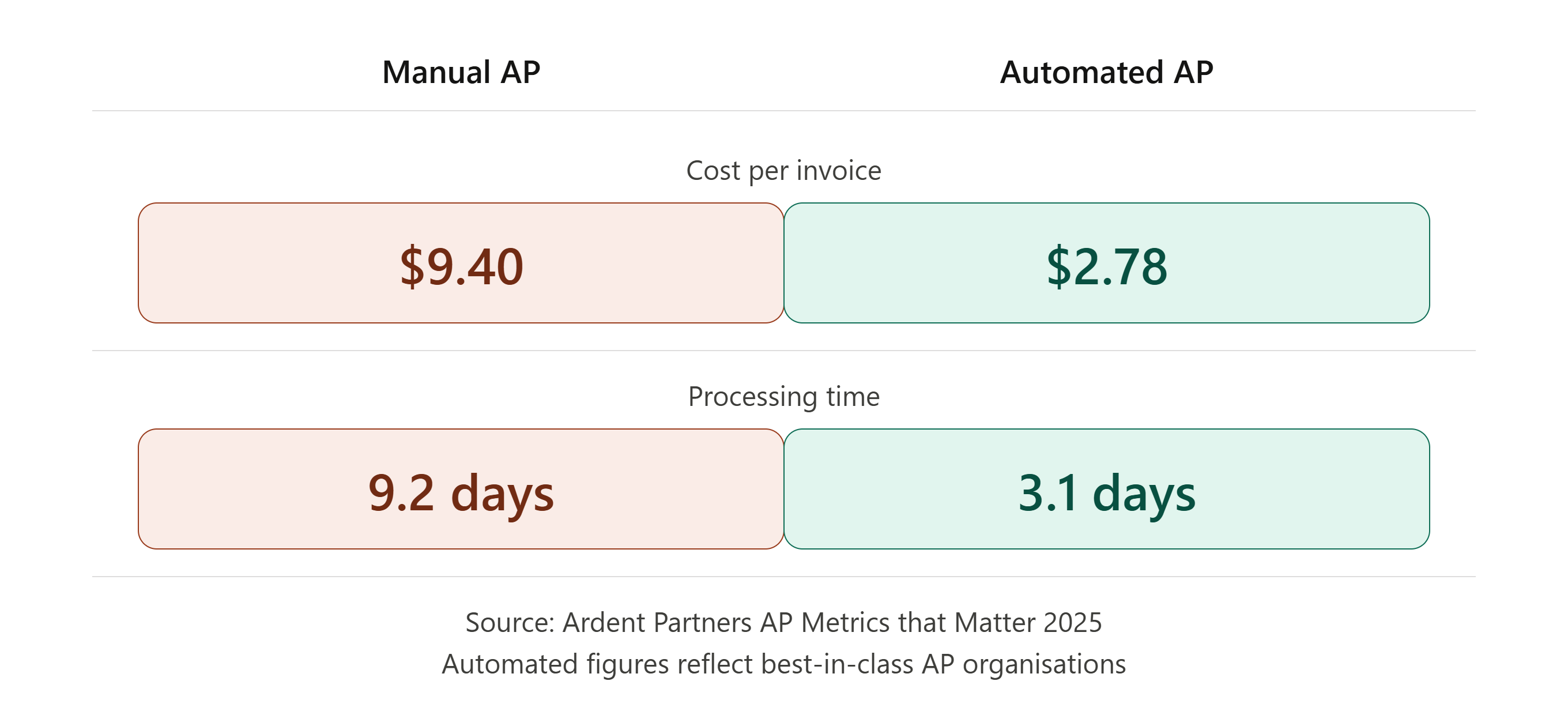
According to Ardent Partners' AP Metrics that Matter in 2025, the average organisation spends $9.40 to process a single invoice and takes 9.2 days to complete it. Best-in-class AP teams using automation have reduced that cost to just $2.78 per invoice and process in as little as 3.1 days — a transformation that goes straight to the bottom line.
Kefron AP is a cloud-based accounts payable automation platform built for mid-market and enterprise organisations. It was developed in 2020 as a pivot from Kefron's traditional document management business, which had spent decades managing, digitising, and handling critical business information for organisations across Ireland and the UK.
Kefron AP uses AI to extract structured data from unstructured invoice documents — far beyond what traditional OCR could achieve. A company processing 20,000 invoices a month can reduce manual entry to near zero, dramatically cutting processing time and costs. The platform consistently delivers 99%+ accuracy through a combination of machine learning and expert data engineering, so finance teams are not left correcting errors downstream.
Rather than replacing existing ERP systems, Kefron AP bolts on alongside them. The platform connects to 70+ ERP systems, including Oracle, SAP, and Sage, covering both cloud and on-premise installations, feeding reporting and workflow data back to finance teams without requiring a full system migration.
Kefron uses AI to flag changes to supplier bank details at the point of invoice receipt, one of the highest-risk moments in any AP process. This proactive monitoring reduces exposure to payment fraud at the source.
For too long, the AP function has operated in arrears, producing management accounts after the fact and measuring performance retrospectively. Kearns argues this is changing, and technology is driving a more forward-looking, strategic role for finance teams.
Kefron's approach is designed to work around that challenge, giving organisations the analytics and control of modern AP automation without forcing them to replace their core infrastructure.
| Traditional AP | Automated AP with Kefron |
|---|---|
| Manual invoice data entry | AI-powered invoice capture |
| Slow, paper-based approvals | Automated digital workflows |
| Retrospective reporting | Real-time financial visibility |
| High error and fraud risk | AI validation and fraud detection |
| Headcount scales with volume | Scale without adding staff |
A common concern about automation is job displacement. Kearns is direct on this point: AI will redefine accounts payable roles, not eliminate them.
What organisations gain is the ability to grow their business without growing their AP headcount, access better data faster, and give their people more meaningful work, analytical and strategic tasks rather than repetitive data entry. Ardent Partners reports that 75% of AP departments now use some form of AI, with best-in-class organisations achieving 49.2% touchless invoice processing, nearly triple the industry average of 32.6%.
Expert Insight: Many finance teams focus on reducing invoice processing time. However, the greatest long-term value often comes from improved cash flow visibility and stronger financial controls, capabilities that only become possible when staff are freed from manual processing.
Eliminating manual data entry at scale significantly reduces the cost per invoice. Finance teams process more volume with the same or fewer resources. See how organisations across different sectors have achieved this in Kefron's customer case studies.
Automated routing means invoices move through approval chains in hours rather than days — improving supplier relationships and enabling early payment discounts.
AI-powered capture and validation removes the human errors that come with manual entry, reducing duplicate payments and reconciliation work. Kefron's managed data service targets 99%+ accuracy without requiring finance teams to correct extraction errors themselves.
Real-time data from automated AP gives CFOs and finance directors an accurate, up-to-date picture of outstanding liabilities and upcoming payments.
Automated audit trails, approval records, and fraud detection capabilities make it far easier to demonstrate compliance, particularly as e-invoicing regulations tighten across Europe.
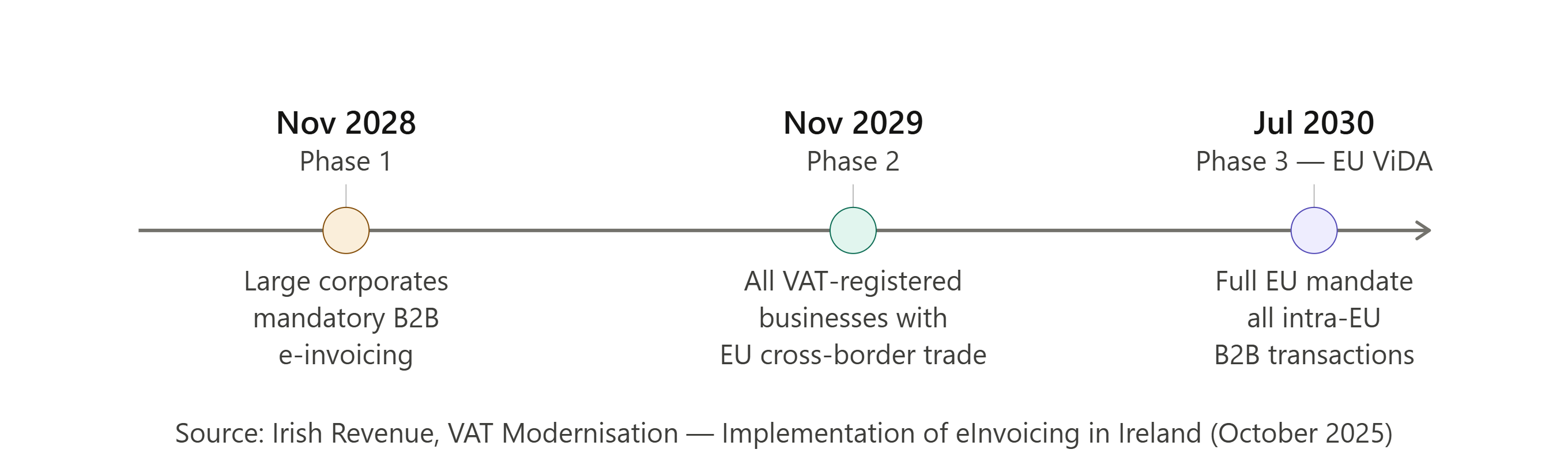
One of the most significant growth drivers on the horizon is European e-invoicing legislation. Ireland's Revenue Commissioners announced a phased rollout of mandatory B2B e-invoicing in October 2025, with large corporates required to comply from November 2028. This rollout is designed to align Ireland with the EU's VAT in the Digital Age (ViDA) directive, which mandates structured e-invoicing for all cross-border B2B transactions across EU member states from July 2030.
For businesses operating in Ireland, the UK, and across the EU, this regulatory shift means that AP automation is no longer a nice-to-have, it is becoming essential infrastructure. From November 2028, all businesses in Ireland will also be required to have the capability to receive e-invoices, regardless of their size. The time to prepare is now.
Kefron today has 300 customers globally, predominantly across the UK and Ireland, with a US operation launched approximately one year ago already serving multiple customers. The technology team is based in Ireland, with a sales and marketing office in London and a recently opened New York office leading North American expansion.
The business is privately held and bootstrapped, funded by its stable traditional document management business and is targeting the mid-market segment, which Kearns identifies as large and underserved when it comes to AP automation.
What is accounts payable automation? Accounts payable automation is software that automatically captures, validates, and processes supplier invoices, replacing manual data entry with AI-driven workflows.
How does Kefron AP work? Kefron AP uses AI to extract data from invoices, validate it, route it through approval workflows, and integrate the results back into your existing ERP system — whether cloud-based or on-premise.
Will AP automation replace finance jobs? No. AP automation redefines finance roles by removing repetitive data entry and freeing staff for higher-value work such as cash flow forecasting, supplier analysis, and financial planning.
Does Kefron AP integrate with existing ERP systems? Yes. Kefron AP connects to 70+ ERP systems including Oracle, SAP, and Sage, covering both cloud and on-premise installations. Businesses do not need to replace their existing infrastructure.
What is e-invoicing and why does it matter for Irish businesses? E-invoicing refers to the digital exchange of structured invoice data between businesses and, increasingly, government tax authorities. Ireland's Revenue has announced mandatory B2B e-invoicing from November 2028 for large corporates, ahead of the EU-wide ViDA mandate in July 2030. AP automation is the foundation businesses need to comply.
How quickly can AP automation scale? Because Kefron AP is cloud-based and integrates with existing systems, organisations can scale invoice processing volume without adding headcount, making it particularly suited to growing businesses.
The role of the CFO and the accounts payable function are evolving rapidly. AI-powered automation is turning AP from a back-office cost centre into a source of strategic insight, improving cash flow visibility, reducing fraud risk, and enabling finance teams to do more meaningful work.
Kefron AP is designed to meet organisations where they are, integrating with existing ERP infrastructure and scaling with business growth. With Irish and European e-invoicing mandates accelerating adoption and the US mid-market representing a major opportunity, the case for AP automation has never been clearer.