.png?width=120&height=120&name=Favicon%20(500%20x%20500%20px).png)

Choosing an ITAD Provider in Ireland for Commercial Businesses
Choosing an ITAD provider is one of those decisions that looks straightforward until something goes...

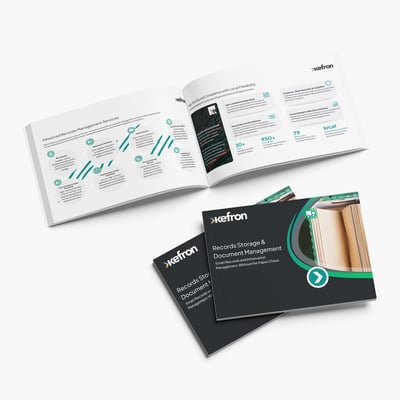
Records and document storage solutions help organisations securely store, manage, retrieve and ultimately dispose of business records throughout their lifecycle. They can include secure off-site document storage, document indexing and retrieval, retention management, scanning, digital access and confidential destruction.
For organisations managing large volumes of contracts, financial records, employee files, legal documents or historical archives, professional records storage provides more than additional space. It creates a controlled system for protecting information while keeping records accessible when the business needs them.
This guide explains how records storage works, what professional storage providers offer, how it fits into wider record information management, and what businesses should consider when choosing a provider.
Records and document storage solutions are services and systems used to securely store, organise, retrieve, retain and dispose of business records.
They are commonly used when organisations need to retain physical information but do not want large volumes of files occupying offices, warehouses or filing rooms.
Records may include:
Professional storage goes beyond placing documents into boxes and moving them off-site. Records need to remain identifiable, traceable and retrievable throughout the period in which they are retained.
Storage is therefore only one component of a wider records and information management strategy.
The internationally recognised ISO 15489-1 standard for records management sets out concepts and principles for the creation, capture and management of records, reinforcing the importance of managing records systematically rather than treating storage as an isolated activity. Learn more about ISO 15489-1.
Records storage facilities are dedicated environments designed for the controlled storage and management of business records.
When documents are transferred to an off-site provider, they are typically catalogued and assigned identifiers so that their location can be tracked. Organisations can then request particular boxes or files when records are required.
A typical records storage process includes:
For particularly sensitive or high-value information, organisations may need specialist secure storage with additional controls around access, environmental conditions and security.
This structured approach is important because organisations need to understand not only where information is stored but also what information they hold, why they hold it and when it should be reviewed.
For many businesses, physical records accumulate gradually. Filing cabinets become full, archive rooms expand and documents may become distributed across different offices and storage locations.
Professional document storage can bring those records into a more controlled environment.
Inactive records can occupy significant space despite being accessed only occasionally.
Moving suitable records to off-site document storage allows organisations to use office and operational space more productively while continuing to retain information that is still required.
Sensitive records should not simply be stored wherever spare space is available.
Professional records storage facilities can provide controlled access, tracking and physical security for confidential employee, customer, financial, legal and operational information.
Where personal data is involved, security is also an important data protection consideration. The Irish Data Protection Commission states that personal data should be processed in a way that ensures appropriate security and confidentiality, including protection against unauthorised access, accidental loss, destruction or damage. See the Data Protection Commission's data protection principles.
A document may technically be stored while still being extremely difficult to find.
One of the main differences between basic warehousing and professional records storage is retrievability.
Indexing and tracking allow an organisation to identify where records are located and retrieve them when required.
Organisations that maintain substantial archives within their own premises may also use on-site document management to introduce more structured indexing, cataloguing and records control.
Keeping every record indefinitely is not an effective records-management strategy.
Different categories of records may have different legal, regulatory, contractual and operational retention requirements.
For personal data specifically, the Irish Data Protection Commission explains that the GDPR's storage limitation principle requires personal information to be kept for no longer than necessary for the purpose for which it is processed. The GDPR does not prescribe a single retention period for every type of personal data, so organisations must determine appropriate periods based on purpose and other applicable statutory obligations. Read the DPC guidance on retaining personal data.
A properly managed storage programme can support this process by associating records with retention and review requirements.
Records may contain information needed for audits, legal matters, financial processes, regulatory requests or normal business operations.
A structured records management approach makes it easier to establish what information exists, where it is held and how it can be retrieved.
The terms records storage and document storage are often used interchangeably, but there is a useful distinction.
A document is recorded information. A record is information retained as evidence of an activity, decision, transaction or obligation and managed according to relevant business requirements.
For example, a draft internal document may simply be a working document, while an executed contract may become an official business record that needs to be retained according to an established policy.
| Document Storage | Records Storage |
|---|---|
| Focuses on storing documents | Forms part of the wider records lifecycle |
| May include active and reference material | Often involves formal business records |
| Storage and retrieval are central | Retention, control and disposition are also important |
| Can be physical or digital | Usually governed through records-management processes |
The important issue for a business is therefore not simply what terminology a provider uses. It is whether the service gives the organisation sufficient control over its information.
Kefron's wider information management services combine physical records management with digitisation and digital document management, allowing different categories of information to be handled appropriately.
Record information management, more commonly called records and information management or RIM, is the systematic management of records and information throughout their lifecycle.
Storage is only one part of this lifecycle.
A typical records lifecycle can be viewed as:
Creation → Classification → Storage → Access → Retention → Review → Disposition
Good record information management therefore considers questions such as:
Official Irish Freedom of Information guidance also recognises the role of records management in effective information retrieval, including record creation, routine retention and destruction. See Ireland's FOI Code of Practice.
This is why choosing between record storage companies based only on the cost of storing a box can be short-sighted. Storage should support the organisation's wider information-management requirements.
Digitisation has reduced the volume of paper used by many organisations, but it has not eliminated the need for physical records.
Businesses frequently operate a hybrid information environment containing both physical and digital records.
| Physical Records Storage | Digital Document Storage |
|---|---|
| Original paper files are retained | Documents are stored electronically |
| Requires physical storage capacity | Requires digital infrastructure |
| Physical retrieval may be required | Files can be retrieved electronically |
| Appropriate where originals need to remain physical | Useful for information accessed regularly |
| Requires physical security controls | Requires digital security and access controls |
| Can be combined with scan-on-demand | Supports electronic search and workflows |
The right approach depends on the record.
Frequently accessed files may benefit from document scanning and digitisation, while other records may continue to require physical retention for legal, evidential, historical or operational reasons.
Once information has been digitised, an online document management system can provide searchable and controlled access to electronic files.
The objective should therefore be appropriate information management, rather than simply digitising every box or retaining every physical record indefinitely.
The services available can vary considerably between record storage companies.
A comprehensive provider may offer the following.
Physical documents are transferred from an organisation's premises into dedicated document storage facilities.
Records are assigned identifiers so their location and movement can be monitored.
Authorised users can request stored records when they need access to them.
Depending on the service model, retrieval may involve returning a physical box or file or supplying selected information electronically.
Instead of returning an entire physical file, a requested document can be scanned and supplied digitally.
This can be useful for organisations with large physical archives that only occasionally need individual files.
Larger archives can be converted into searchable digital information through a structured digitisation and document scanning project.
Digitisation can reduce dependence on physical retrieval while supporting digital information management.
Records can be associated with retention schedules and review dates so that organisations can identify information approaching the end of its required retention period.
Once records have reached the end of an approved retention period, secure destruction may form the final stage of their lifecycle.
Records should not, however, be destroyed simply because they are old. The organisation should first consider relevant retention policies, statutory obligations, litigation requirements and other legitimate reasons for continued retention.
Not all document storage companies provide the same level of records-management capability.
When evaluating potential providers, businesses should look beyond price per box and consider how well the service supports the complete records lifecycle.
Ask how the facility, individual records and retrieval requests are controlled.
Consider:
For records requiring a higher level of protection, organisations may need specialist secure document storage.
The provider should be able to identify where records are stored and maintain visibility when files or boxes are removed, delivered or returned.
Without effective tracking, off-site storage can simply relocate an existing information-management problem.
Consider how quickly your organisation may need access to stored records.
Ask whether the provider offers:
The right model will depend largely on how frequently archived information needs to be accessed.
A records storage provider should support your retention framework rather than encouraging indefinite storage.
Consider whether records can be assigned retention or review dates and how authorised destruction is managed.
Storage requirements change.
Acquisitions, office relocations, regulatory projects and long-term business growth can all increase records volumes.
A suitable provider should be capable of scaling with these changes without requiring an organisation to rebuild its information-management process.
Even if the immediate requirement is physical storage, consider whether some records are likely to be digitised in the future.
Working with a provider that combines records storage with digitisation and data capture can make the transition towards hybrid or digital records management easier.
Perhaps most importantly, assess whether the company understands records management, not simply storage.
A strong records management service should help maintain control over information throughout its lifecycle, including storage, retrieval, retention and disposition.
A common mistake is treating document storage as an indefinite destination.
A better model is:
Create → Use → Store → Review → Digitise / Archive / Destroy
A record may initially be accessed every day. Later it becomes inactive but still needs to be retained. It may then move to off-site storage before ultimately reaching its approved disposition point.
This lifecycle approach helps prevent organisations from continually accumulating documents without understanding whether they still need them.
The biggest records storage problem is often not lack of space. It is lack of visibility.
If an organisation cannot confidently identify what it holds, where records are located, who can access them and how long they should be retained, adding additional storage capacity does not solve the underlying records-management problem.
Professional storage should create control over information, not simply additional shelf space.
Organisations reviewing their records should begin with the information itself rather than immediately choosing a storage facility.
Start by identifying:
From there, records can be classified according to the most appropriate management method.
→ Use document scanning and digitisation and provide controlled electronic access.
→ Move the records to secure off-site document storage.
→ Consider specialist secure storage.
→ Use off-site storage with retrieval or scan-on-demand capability.
→ Introduce structured on-site document management.
→ Review whether they can be securely disposed of, subject to applicable legal, regulatory and business requirements.
This approach creates a more efficient information environment than treating every document in exactly the same way.
Records storage facilities are dedicated locations used to securely store and manage physical business records away from an organisation's main premises. Professional facilities may combine physical storage with indexing, tracking, retrieval and records-management services.
Record storage companies collect, catalogue, store, track and retrieve physical business records. Depending on the provider, they may also offer retention management, document scanning, scan-on-demand services and secure destruction.
Record storage focuses primarily on where and how records are kept. Records management covers the wider lifecycle of information, including classification, access, storage, retention, review and final disposition.
Off-site document storage can free office space, centralise archived records, improve tracking and provide a controlled environment for information that needs to be retained but is not regularly accessed.
Yes. Many physical records can be converted into electronic files through document digitisation.
However, whether the original should subsequently be destroyed depends on the nature of the record and any applicable legal, regulatory, evidential or operational requirements.
There is no single retention period that applies to every category of business record.
Retention periods depend on the type and purpose of the record, applicable legislation and regulation, contractual requirements and legitimate operational needs.
For personal data, organisations also need to comply with the GDPR storage limitation principle and avoid keeping identifiable personal information for longer than necessary.
Businesses should assess security, access controls, records tracking, retrieval options, retention support, secure destruction procedures, scalability and digitisation capabilities.
Most importantly, the provider should support the organisation's broader records-management strategy rather than simply providing storage space.
Most organisations do not need to choose one method exclusively.
A hybrid strategy can combine secure physical document storage with an online document management system, allowing records to remain physical where necessary while providing digital access to information that is used more frequently.
Effective records and document storage is not about keeping more information for longer.
It is about keeping the right information, in the right environment, for the right period of time — while ensuring it can be found when needed.
For organisations with growing physical archives, professional storage can reduce pressure on office space while bringing greater structure to document retrieval, retention and eventual disposition.
Combining physical storage with scanning, digital access and structured records management can also provide a practical route towards a more efficient hybrid information environment.
Explore Kefron's Records and Information Management solutions to see how secure document storage, records management, retrieval and specialist storage can help businesses take greater control of their information.