Choosing accounts payable automation software for a multi-entity operation in the UK or Ireland means dealing with distinct VAT rules, local compliance requirements, and the challenge of consolidating invoices across several legal entities.
If your finance team is still manually routing invoices between subsidiaries or re-keying data into multiple ERP instances, the right AP platform can cut that workload significantly.
Kefron AP helps mid-market finance teams automate invoice capture, approval workflows, and ERP integration across entities, with 99%+ data accuracy and support for over 70 ERP systems. This article walks through the key criteria you should evaluate when selecting AP automation software for multi-entity operations in the UK and Ireland.
Key Takeaways: AP Automation for Multi-Entity Finance in the UK and Ireland
- Multi-entity AP automation should consolidate invoices, approvals, and reporting into a single platform for all entities.
- ERP compatibility across all your entities is non-negotiable when shortlisting AP automation vendors for evaluation.
- UK and Irish VAT, e-invoicing, and Making Tax Digital rules demand built-in compliance tools from your AP platform.
- Kefron AP offers AI-powered data capture with dedicated human validation, delivering 99%+ accuracy for multi-entity teams.
- Scalable approval workflows let you add new entities or subsidiaries without rebuilding your entire AP process from scratch.
What to Look for in AP Automation Software for Multi-Entity Operations
1. Multi-Entity Invoice Consolidation
When you run multiple legal entities, invoices arrive in different formats, from different suppliers, addressed to different company names. Your AP automation platform needs to route each invoice to the correct entity automatically, without someone manually sorting a shared inbox every morning.
Look for software that uses smart identifiers to assign invoices to the right branch, department, or subsidiary at the point of capture. This removes the need for manual sorting and ensures each entity's payables are tracked separately for reporting and compliance.
It also means your team can see outstanding liabilities by entity at any time, rather than waiting for a monthly consolidation exercise.
Kefron AP's automatic routing and capture assigns invoices to the correct entity using intelligent identifiers, so your team spends less time triaging and more time on exception management.
2. ERP Compatibility Across Your Entire Tech Stack
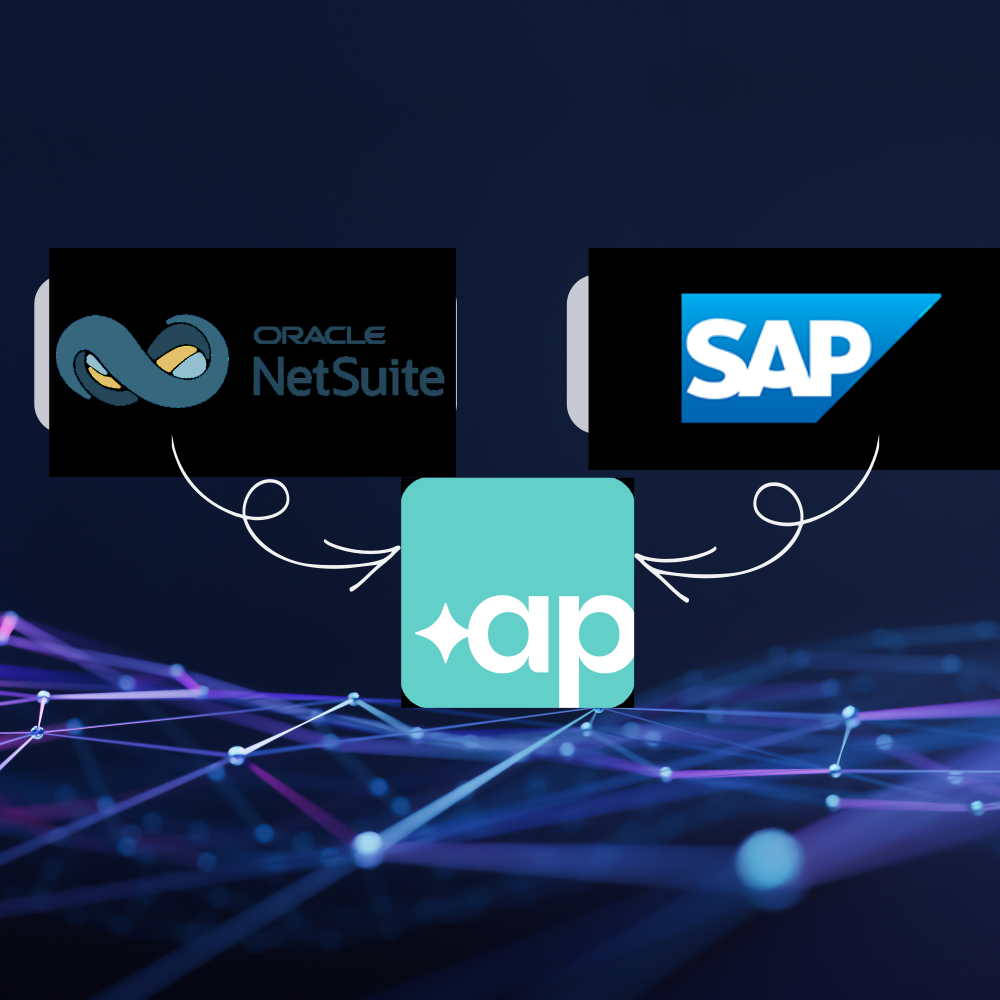
Multi-entity businesses often run more than one ERP. A subsidiary acquired last year might still be on Sage while the parent company uses NetSuite. Your AP software needs to integrate with all of them without requiring middleware workarounds.
Check whether the vendor supports real-time API connections, secure file transfer (SFTP), and custom integrations. According to Gennai's 2026 Invoice Automation report, legacy ERP integration complexity is one of the top three barriers to full AP automation, cited by 28% of finance leaders.
Kefron AP integrates with over 70 ERP and accounting systems, including SAP, Oracle, Microsoft Dynamics, Sage, and NetSuite. Integration happens via direct API, Kefron Konnect (a low-code SFTP bridge), or custom connectors built to match your specific environment.
3. UK and Irish VAT Compliance
Operating across the UK and Ireland means dealing with two separate VAT regimes. Since Brexit, businesses trading across the Irish Sea face additional obligations around customs declarations, reverse charges, and differing VAT rates. Getting tax codes wrong across entities creates reconciliation headaches that compound at month end.
Your AP platform should apply the correct tax codes automatically based on supplier location, entity, and transaction type. It should also support e-invoicing compliance formats including PEPPOL and EN 16931, which are becoming standard across Europe.
Ireland's own e-invoicing mandate is scheduled for November 2028, and the EU's ViDA framework will affect any Irish business trading with European suppliers. HMRC's Making Tax Digital programme continues to expand in the UK. Businesses that start preparing now will avoid a scramble when these deadlines arrive.
4. AI-Powered Data Capture and Validation
Manual data entry is the single biggest time drain in most AP departments. Research from Ardent Partners shows a 78% cost gap between best-in-class AP teams and average performers, and the difference comes down to how much manual keying each invoice requires.
Look for AI-driven extraction that handles header and line-item data from PDFs, scans, XML, and EDI files. Accuracy rates should be verifiable, not just claimed. Kefron AP delivers 99%+ data accuracy by combining machine learning extraction with a dedicated Data Assurance Team that validates uncertain fields in real time.
5. Flexible Approval Workflows
Each entity in your group likely has different approval thresholds, departmental structures, and spending policies. A rigid, one-size-fits-all workflow will either slow you down or force your team to create workarounds outside the system.
Your AP software should let you configure custom approval hierarchies by entity, department, value, or supplier. Automated reminders for overdue approvals help keep invoices moving, and a full timestamped audit trail means you can prove exactly who approved what and when.
This is especially important for businesses operating across the UK and Ireland, where different entities may have different governance requirements. Having entity-specific workflows that feed into a centralised approval dashboard gives you both local control and group-level oversight.
6. Line-Level PO and GRN Matching
Two-way and three-way matching are table stakes for any serious AP platform. But for multi-entity operations, you need matching that works at the line-item level and connects to PO and goods received note (GRN) data from whichever ERP each entity uses.
Automated matching flags discrepancies like price variances, quantity mismatches, and missing GRNs before invoices move to approval. This prevents overpayments and reduces the time your team spends chasing purchasing and warehouse teams for clarification.
Kefron AP's AI-driven PO matching handles these scenarios at the line level, with automated prompts that help resolve exceptions quickly.
7. Centralised Visibility and Reporting
Finance directors and CFOs need a single view of payables across all entities. If your reporting requires pulling data from three separate systems and consolidating it in a spreadsheet, you are losing time and introducing errors.
Your AP platform should include real-time dashboards that let you filter by entity, supplier, department, or approval status. This gives leadership accurate, up-to-date information for cash flow management and month-end close without additional manual effort.
For multi-entity operations, reporting should also support cross-entity comparison. You should be able to see which entities have approval bottlenecks, which are processing invoices fastest, and where exception rates are highest. This kind of visibility helps you identify process improvements across the group, not just entity by entity.
8. Scalability for Growth and Acquisitions
Mid-market businesses in the UK and Ireland grow through acquisition as often as they grow organically. When you bring a new entity into the group, you need your AP automation to extend to that entity without a major re-implementation project that ties up your finance and IT teams for months.
Evaluate whether the vendor charges per user or per entity, and whether adding new entities requires significant configuration time. Kefron AP offers unlimited users across all roles, entities, and suppliers, which means you can bring on new subsidiaries, approvers, and vendors without unexpected licensing costs.
9. Supplier Collaboration Tools
For multi-entity businesses, supplier queries multiply quickly. A vendor might invoice three of your entities and need status updates on all three. If your AP team handles these queries by email, the back-and-forth creates delays and frustration on both sides.
Look for self-service portals where suppliers can submit invoices, check payment status, and resolve queries directly. This reduces inbound emails and calls, and it keeps your AP team focused on processing rather than answering "where's my payment?" questions.
Strong supplier collaboration also helps you capture early-payment discounts. When invoices move through your system faster and suppliers can see the progress, you can negotiate better payment terms with confidence that your team can meet them.
10. Handling Non-PO Invoices Efficiently
Not every invoice in a multi-entity operation is tied to a purchase order. Utility bills, subscription fees, consultancy charges, and ad-hoc expenses often arrive without a PO reference.
Across multiple entities, the volume of these non-PO invoices adds up quickly. They can be the hardest to process because they need manual coding and routing.
Your AP platform should automate GL coding for recurring non-PO invoices based on historical patterns. AI-driven coding learns from past transactions and applies the correct cost centre, department, and GL code automatically.
This reduces the time your team spends on repetitive manual allocation and keeps your month-end close on track, even when non-PO volume spikes.
Why Multi-Entity AP Automation Matters Now
The regulatory environment across the UK and Ireland is changing quickly. HMRC's Making Tax Digital programme is expanding, and Ireland is moving toward mandatory e-invoicing by 2028.
The EU's VAT in the Digital Age (ViDA) framework will affect any Irish entity trading with European suppliers. Waiting to automate means handling these changes manually, which puts your team under more pressure at exactly the point when you need more control.
According to Gennai's 2026 research, only 8% of finance teams have achieved full end-to-end automation, even though 75% use some form of automation tool. The gap is rarely about the technology. It is about configuring the right platform thoroughly across all entities, workflows, and ERP connections.
For mid-market businesses in the UK and Ireland, the opportunity is significant. Ardent Partners' 2025 data shows best-in-class AP teams process invoices at $2.78 each, while average teams spend $12.88 per invoice.
At 500 invoices per month, that gap adds up to more than $60,000 a year in excess cost. The ROI case for automation is strongest when you configure it fully across every entity and workflow.
Kefron AP is built for this kind of complexity. With direct ERP integrations, AI-powered data capture, multi-entity routing, and dedicated implementation support, it gives mid-market finance teams a clear path to a fully automated, audit-ready operation.
If you want to see how it works for your specific setup, book a demo with the Kefron AP team.
FAQs About AP Automation for Multi-Entity Finance in the UK and Ireland
What is multi-entity AP automation?
Multi-entity AP automation is software that processes invoices across several legal entities from a single platform. It routes invoices to the correct subsidiary, applies entity-specific coding and approval rules, and consolidates reporting so finance leaders get a unified view of payables across the entire group.
How does AP automation handle different VAT rules in the UK and Ireland?
A well-configured AP platform applies the correct VAT treatment based on the entity, supplier location, and transaction type. This includes handling reverse charges, different rates across jurisdictions, and e-invoicing requirements as they come into force.
Can AP automation software integrate with multiple ERPs at once?
Yes. Platforms like Kefron AP support multi-ERP environments, so you can process invoices centrally while posting approved data into different ERP instances with the correct entity-level mappings. This is particularly useful after mergers or acquisitions.
How long does it take to implement AP automation for a multi-entity business?
Timelines vary depending on the number of entities and ERP complexity. Kefron AP typically goes live in six to eight weeks with guided onboarding from a dedicated Implementation Consultant.
Multi-entity environments with heavily customised ERPs may take slightly longer for full mapping and testing, but the structured rollout keeps the process predictable.
What ROI can a mid-market business expect from AP automation?
The return on investment typically comes from lower cost per invoice, faster cycle times, fewer duplicate payments, and reduced manual headcount requirements. Industry benchmarks consistently show that fully automated teams spend a fraction of what manual teams spend per invoice, with payback periods of three to nine months being typical.
Is AP automation secure enough for regulated industries?
Yes. Kefron AP is accredited to Cyber Essentials and Cyber Essentials+ standards and runs on Microsoft Azure's secure cloud infrastructure. Role-based access, SSO, encrypted data, duplicate and fraud checks, and a full timestamped audit trail protect your AP data end to end.
This makes it well suited for sectors like healthcare, financial services, and the public sector where data governance is critical.

.png?width=400&name=Untitled%20design%20(26).png)