
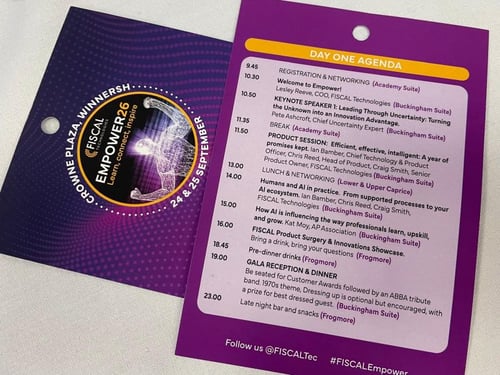
Putting Finance Transformation Into Practice: Highlights From the FISCAL EMPOWER Partner Panel
On Friday 25th September, the FISCAL EMPOWER partner panel brought together leading voices from...

Selecting AP automation for NetSuite and SAP is not a simple feature comparison. Your ERP environment, approval structures, data volumes, and compliance requirements all shape which platform will actually work for your finance team.
This article walks through 10 essential questions to ask before you commit. Whether you run NetSuite, SAP S/4HANA, SAP ECC6, or SAP Business One, these questions will help you assess integration fit, accuracy, workflows, and long-term vendor support.
Kefron AP gives mid-market finance teams a direct path to reliable invoice automation across both ERP platforms, backed by AI-powered data capture and a dedicated support model.
A direct API connection with NetSuite or SAP means invoice data, purchase orders, GL codes, and vendor records sync in real time. This eliminates file exports, CSV uploads, and manual reconciliation steps that slow down your finance team.
Ask vendors whether their integration uses native REST APIs or requires middleware. Middleware adds another layer to maintain, troubleshoot, and update over time. Solutions like Kefron AP for NetSuite use a certified direct API, so data flows between systems without IT workarounds or third-party dependencies.
If your organisation runs multiple subsidiaries in NetSuite or multiple company codes in SAP, you need automation that respects those boundaries. Ask how the tool routes invoices across entities and whether it supports intercompany transactions, cross-entity approvals, and consolidated reporting natively.
Multi-currency processing is equally important for teams working with international suppliers. Your AP tool should apply the correct exchange rates automatically, convert amounts at posting time, and sync to the right ledger regardless of the currency printed on each supplier invoice.
Accuracy is the difference between touchless processing and constant manual corrections. Ask vendors for their first-pass extraction rate, how they handle exceptions, and whether accuracy improves over time as the system learns your specific supplier formats and layouts.
Some platforms rely solely on OCR, which can drop below 85% on non-standard invoice formats or scanned documents. Kefron AP combines AI extraction with a human Data Assurance team, delivering 99%+ accuracy with no templates to build, no rules to configure, and consistent results from day one.
Rigid approval routing forces you to change your internal processes around the software rather than the other way around. Look for platforms that let you route invoices by vendor, department, cost centre, value threshold, or entity, and that support conditional logic for unusual edge cases and exceptions.
Ask whether the system supports multi-level approval hierarchies, escalation rules, delegation during absences, and automated reminders for pending approvers. This flexibility reduces approval bottlenecks and keeps month-end close on track without manual chasing or email follow-ups.
Most mid-market finance teams process a mix of PO-backed and non-PO invoices on a daily basis. Your AP automation should handle both types in one unified system without requiring separate manual workflows, additional modules, or workarounds to manage the differences between them.
For PO invoices, ask about line-level 2-way and 3-way matching against goods received notes with automatic exception flagging. For non-PO invoices, check whether the system supports GL coding rules, approver routing, and exception queues that keep processing moving.
Finance regulations like e-invoicing mandates, VAT reporting, and data retention rules vary by region and change frequently. Your automation platform should address these natively rather than relying on paid add-ons, separate compliance tools, or manual record-keeping.
Ask about timestamped audit trails, duplicate detection, e-invoicing support for standards like PEPPOL and CTC, and role-based access controls. According to Ardent Partners' State of ePayables 2025 report, compliance readiness remains a top priority for AP leaders navigating evolving regulatory requirements across multiple jurisdictions.
A long deployment can stall your automation project and frustrate stakeholders who expected faster results. Ask vendors how quickly you can go live, what resources are needed from your IT team, and whether they handle the bulk of configuration on your behalf.
Some platforms require months of scripting, template building, and consultant hours before processing a single invoice. Kefron AP typically goes live in 6 to 8 weeks with guided onboarding, keeping IT involvement minimal and letting your finance team see results quickly.
Implementation is only the starting point for a successful AP automation project. Ask about ongoing optimisation, dedicated account management, regular performance reviews, and how the platform adapts as your ERP environment changes through upgrades, migrations, or acquisitions over the years ahead.
Look for a vendor that assigns a Customer Success Manager to fine-tune accuracy, workflows, and reporting over time. Real customer success stories show how this ongoing partnership ensures automation improves month after month, adapting to new suppliers, changing approval rules, and growing invoice volumes.
Growth through acquisition, new subsidiaries, or increased invoice volumes should not mean renegotiating licence fees every quarter. Ask whether the platform offers unlimited user access across all roles, including approvers, finance staff, suppliers, and external auditors who need visibility.
Unlimited users means everyone involved in the AP process can access the system without cost pressure or seat limitations. This drives faster adoption across departments, removes bottlenecks caused by restricted access, and ensures every stakeholder can review and approve invoices on time.
Duplicate payments and invoice fraud are costly risks that manual processes cannot catch reliably at scale. Ask how the platform detects duplicates before posting and whether it flags suspicious patterns, unusual amounts, or mismatched vendor details automatically in real time.
Look for multi-layer checks that compare invoice numbers, amounts, dates, and supplier details against your existing records before any payment is triggered. Kefron AP uses a three-step verification process with full reporting visibility to catch discrepancies before they reach your ERP and result in overpayment.
Choosing the right AP automation for your ERP comes down to integration depth, accuracy, and the quality of ongoing support. Kefron AP connects directly to both NetSuite and SAP (including S/4HANA, ECC6, and Business One) via native API, giving you real-time sync without middleware or manual imports.
With 99%+ data capture accuracy, flexible approval workflows, and a dedicated team that optimises your setup over time, Kefron AP helps mid-market finance teams process invoices faster and with greater control. Book a demo to see how it fits your specific ERP environment.

Direct API integration is the most critical factor. It ensures real-time data sync between your AP automation and NetSuite, eliminating manual file transfers and reducing errors across your invoice-to-pay cycle.
Yes. Kefron AP integrates with SAP S/4HANA, SAP ECC6, and SAP Business One through direct API connections. Each SAP version has different integration methods, so confirm your vendor supports your specific environment.
Implementation timelines vary by vendor. Kefron AP typically goes live in 6 to 8 weeks with guided onboarding. Ask about IT resource requirements and whether your existing workflows need to change during setup.
Look for vendors delivering above 95% first-pass accuracy. Kefron AP achieves 99%+ by combining AI extraction with human validation, meaning fewer exceptions and higher touchless processing rates from day one.
No. A well-designed platform handles both in a single workflow. Kefron AP automates 2-way and 3-way PO matching alongside rules-based routing for non-PO invoices, so your team manages everything in one place.
AP automation creates timestamped audit trails, enforces approval hierarchies, and detects duplicates automatically. Kefron AP also supports e-invoicing standards and regional tax rules, keeping your organisation audit-ready across jurisdictions.