.png?width=120&height=120&name=Favicon%20(500%20x%20500%20px).png)

What Physical Records Does Your Business Actually Need to Keep?
Physical record retention is a legal obligation for Irish businesses — not just a filing...

Every Irish business holds records it cannot afford to lose and cannot legally ignore. Contracts, employee files, financial statements, deeds, and compliance documentation all accumulate year after year. The question is not whether you need document storage; it is whether your current approach protects those records, keeps them retrievable, and meets the obligations set by Revenue, GDPR, and sector-specific regulators.
This guide covers how document storage works in Ireland, what to look for in a provider, how Irish retention and GDPR rules shape your decisions, and how to organise an archive so records stay accessible without creating compliance exposure. Kefron has supported over 1,000 Irish organisations with secure document storage and records management for more than 30 years, and the practical detail here reflects that experience.
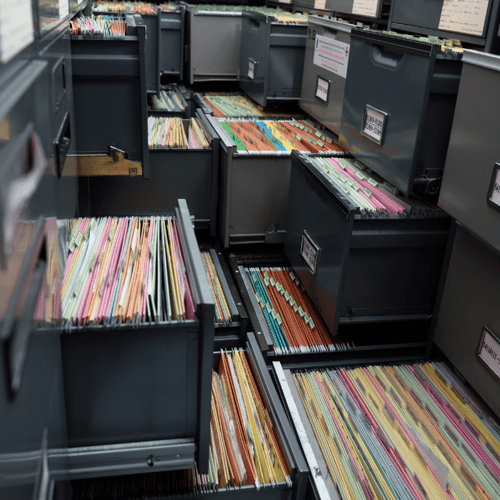
Document storage in Ireland is the practice of keeping physical business records in a secure, controlled environment where they are indexed, protected from damage, and retrievable when needed. It can mean offsite storage in a purpose-built records centre, on-site management by a specialist team, or vault-level protection for high-value legal documents such as deeds and securities.
For Irish businesses, professional document storage addresses two parallel concerns. The first is compliance: Revenue, GDPR, employment law, and the Companies Act 2014 all require certain records to be retained for defined periods.
The second is operational: records that are rarely accessed but must be kept tie up office space, filing equipment, and staff time that could be better directed elsewhere.
The records an Irish business must store fall into several categories, each with its own retention requirements. Financial and tax records, including invoices, receipts, and statements, must be retained for a minimum of six years under Revenue rules.
Employee records, covering contracts, payroll, and disciplinary files, must be held for seven years after the employment relationship ends.
Company incorporation documents, board minutes, and share registers must be kept indefinitely under the Companies Act 2014. Health and safety records carry a minimum retention period of ten years. Healthcare and financial services organisations often face extended retention requirements set by their sector regulator.
Beyond these mandated categories, most businesses also hold operational records such as contracts with suppliers and customers, project files, and correspondence that may be needed for dispute resolution or business continuity.
When records are scattered across filing cabinets, basements, and individual desks without a consistent indexing method, two problems compound. First, finding a specific document during an audit or legal request can take hours or fail entirely. Second, records that should have been destroyed under GDPR retention rules remain in place because nobody knows what they hold or when they arrived.
That dual failure creates regulatory exposure in both directions. Revenue can penalise you for failing to produce records. The Data Protection Commission can investigate you for retaining personal data without a lawful basis.
Your credibility within the organisation, and your team's confidence in the records function, depends on demonstrating that both obligations are met. The person responsible for records management carries that accountability directly.
Selecting a document storage provider is a compliance decision as much as a commercial one. If any of the records contain personal data, your provider becomes a data processor under GDPR. Their security standards, handling procedures, and contractual obligations become your responsibility to verify before a single box leaves your premises.
The first criterion is security certification. Look for ISO 27001 certification for information security management. This confirms that documented, audited controls protect the records stored on your behalf.
Beyond certification, ask about physical security: 24/7 CCTV, monitored alarms, access-controlled entry, fire suppression, and flood risk assessment. A general warehouse with a padlock is not a purpose-built records centre.
Indexing determines how quickly you can locate a specific record. Barcode-based indexing, where every box is tagged and tracked from intake, gives you a full chain of custody and a complete audit trail.
Retrieval speed is the practical test. Ask about tiers: next-day delivery, same-day express, and scan-on-demand for receiving a digital copy without moving the physical file.
Document storage pricing in Ireland depends on volume, the level of indexing required, retrieval frequency, and any specialist requirements such as vault conditions or climate control for media.
A provider that offers only a single pricing tier without visibility into what drives the cost makes it harder to manage the budget as your archive grows. Transparent, itemised pricing gives you control to plan ahead.
Ask specifically about what the base fee includes and what incurs extra charges: box supply, collection, delivery, scanning, retrieval, and certified destruction.
Service-level agreements should cover retrieval turnaround times, the process for urgent requests, how you submit and track orders, and the escalation path if something goes wrong.
Kefron provides an online management portal called O'Neil Order that lets you view, request, and track documents from your desktop, giving you full visibility over your offsite records.
Your document storage approach cannot be separated from your retention obligations. Irish businesses operate under a layered set of rules that dictate not only how long records must be kept but also how and when they must be destroyed. Understanding these rules is the foundation of any compliant storage strategy.
Article 5(1)(e) of the GDPR establishes the storage limitation principle: personal data must not be kept longer than necessary for the purposes for which it was processed. The Irish Data Protection Commission enforces this directly.
Many Irish businesses over-retain out of caution, assuming that keeping everything is safer than deleting something later. Under GDPR, that assumption creates the very exposure it was meant to prevent.
The solution is a documented retention schedule mapping each record category to its destruction date. Your provider should tag records at intake and carry out certified destruction when that date arrives, issuing a certificate of destruction as evidence.
Irish retention periods are governed by Revenue, employment legislation, the Companies Act 2014, and sector-specific regulations. The key periods are summarised below.
Financial and tax records: Revenue requires retention for a minimum of six years from the end of the relevant accounting period.
Employee records: Contracts, payroll, and disciplinary files must be retained for seven years after employment ends. Health and safety records carry a ten-year minimum.
Company records: Under the Companies Act 2014, Section 285, accounting records must be preserved for six years. Incorporation documents and board minutes: indefinitely.
Customer contracts: Retain for the duration of the agreement plus six years, covering the statute of limitations for contract disputes under Irish law.
Regulated sectors: Healthcare, financial services, and legal practices face extended retention requirements set by their sector regulator. Verify specific obligations before setting your retention schedule.
A well-organised archive is not just about tidiness. It is about producing the right record within hours rather than days and demonstrating chain of custody during an audit.
The organisational structure you apply at intake determines how useful the archive will be years later. Get this right from the start, and retrieval stays fast as your archive grows.
Every box and file that enters storage should be tagged with a consistent set of index fields. At minimum, include the department that owns the record, the record category (financial, HR, legal, operational), the date range covered, the retention period, and the scheduled destruction date.
The department and record category fields let you search the archive by function and type. The date range and destruction date fields let you run reports showing which records are due for destruction in a given quarter.
Access restrictions flag records containing sensitive personal data or commercially confidential information, ensuring that retrieval requests are routed to the right approver.
A barcode-based tracking system ties all these fields to a physical box or file. When a record is requested, the system identifies its exact location and tracks it through retrieval and return.
Not every record needs to be physically retrieved. For records accessed occasionally but unpredictably, scan-on-demand provides a digital copy within hours without moving the physical file. This reduces delivery costs and gives you faster access, particularly when the person who needs the record is in a different location.
For larger volumes, a full digitisation project converts an entire physical archive into indexed, searchable digital files. The originals remain in secure storage while the digital copies are accessible through a document management system.
Kefron's digitisation and scanning service handles both high-volume archive conversion and ongoing scan-on-demand, with digital files stored in a GDPR-compliant repository accessible from any location.
The physical environment in which records are stored directly affects how long they last and whether they remain legible and intact when you need them. Different record types require different conditions, and using the wrong box or the wrong environment can degrade records long before their retention period expires.
Standard cardboard boxes work for general business records with medium-term retention. For longer retention, acid-free boxes prevent the chemical degradation that causes paper to yellow and become brittle. The National Archives of Ireland specifies acid-free archival boxes for records of permanent value.
Kefron provides custom-designed storage boxes with a seven-year lifespan, built to protect physical records throughout their retention period.
Backup tapes, hard drives, and other physical media require conditions that prevent magnetic degradation, static damage, and moisture exposure.
Storing backup media in the same building as the primary systems it protects is not a disaster recovery plan. It is a single point of failure that leaves your organisation exposed when you need resilience most.
Deeds, securities, legal agreements, wills, and other high-value documents require climate-controlled vault storage. Temperature and humidity fluctuations cause paper to expand and contract, accelerating deterioration and making ink fade. A vault environment maintains consistent conditions year-round, preventing this damage entirely.
Kefron's vault and deed storage includes four-hour fire-rated protection, Very Early Smoke Detection Apparatus (VESDA), 24-hour monitored access, and a full audit trail of all access activity. This level of protection is designed for legal firms, financial institutions, and property companies whose documents have long-term legal significance and cannot be replaced.
For general offsite storage, the records centre should still meet baseline environmental standards: fire suppression, flood protection (including being located outside flood-risk zones), raised storage systems to prevent ground-level water damage, and regular roof and facility inspections. These are not optional features; they are the minimum standard for a purpose-built document storage facility.
The cost of document storage in Ireland depends on volume, indexing complexity, retrieval frequency, and the services included in your contract.
Offsite storage is typically more cost-effective than maintaining an in-house archive. Office space in Dublin and other Irish cities costs significantly more per square metre than purpose-built records centre space.
When you factor in staff time spent filing, searching, and managing records, the total cost of in-house storage is often higher than a professional service fee.
The most useful way to evaluate cost is to compare total cost of ownership: space, staff time, compliance risk, and potential penalties versus professional storage with built-in retrieval, indexing, and destruction.
A provider that gives you transparent, itemised pricing and an online portal for managing requests makes it straightforward to forecast and control your spend.
Document storage in Ireland is not a single decision. It is a set of connected decisions about what to keep, how long to keep it, where to store it, how to organise it, and when to destroy it. Each decision has compliance implications under Revenue rules, GDPR, and sector-specific regulations.
Start with a retention schedule that maps every record category to its legally required retention period and destruction date. Choose a provider with ISO 27001 certification, barcode indexing, and GDPR data processor status.
Organise your archive using consistent index fields so records stay findable. Review regularly to confirm records are destroyed on schedule.
Kefron has worked with over 1,000 Irish organisations for more than 30 years. If records storage is creating compliance uncertainty or operational friction, talking to a specialist is the practical next step.

Document storage is the secure holding of physical records in a controlled environment. Records management covers the entire lifecycle, from creation through active use, retention, and compliant disposal. Kefron delivers both as an integrated service, using barcode indexing and retention scheduling to manage each record through every stage.
Revenue requires Irish businesses to retain financial and tax records for a minimum of six years from the end of the relevant accounting period. Company incorporation documents and board minutes should be kept indefinitely under the Companies Act 2014.
Yes. Article 5(1)(e) of the GDPR requires that personal data is not held longer than necessary for its original purpose. The Irish Data Protection Commission can investigate and sanction organisations that retain personal data without a lawful basis for continued storage.
At minimum, look for ISO 27001 certification for information security management. Kefron also holds ISO 9001 for quality management and ISO 14001 for environmental management, covering the full scope of secure, compliant, and sustainable records storage.
Scan-on-demand lets you request a digital copy of a stored physical record without transporting the original. Kefron locates the file using barcode tracking, scans it at the records centre, and delivers the digital copy to you, typically within hours. The physical record stays securely in storage.
Deeds, securities, wills, legal agreements, and other high-value documents that cannot be replaced require vault storage with temperature and humidity control. Kefron's vault facilities include four-hour fire-rated protection, VESDA smoke detection, and 24-hour monitored access for these categories.