.png?width=120&height=120&name=Favicon%20(500%20x%20500%20px).png)

Archive Scanning Services: A Guide for Businesses
Every organisation accumulates records that outlive their daily usefulness but remain too important...

Document scanning services convert physical paper records into searchable, indexed digital files. For businesses in the UK and Ireland, they are the fastest route to eliminating paper-based inefficiencies, reducing storage costs and meeting GDPR obligations. In this guide, you will learn what professional document scanning involves, what bulk and secure scanning look like in practice, how much it costs and how to choose the right provider.
Document scanning services are professional solutions that convert physical paper documents into digital files that can be stored, searched and retrieved electronically. A full-service provider does far more than scan — they prepare, index, quality-check and deliver documents directly into your document management system or business application.
According to AIIM, over 45% of business processes are still paper-based, and organisations that embrace intelligent document automation report productivity gains of up to 2x and process cycles 30–50% faster. Despite the availability of technology, paper remains one of the most persistent operational bottlenecks for UK and Irish businesses.
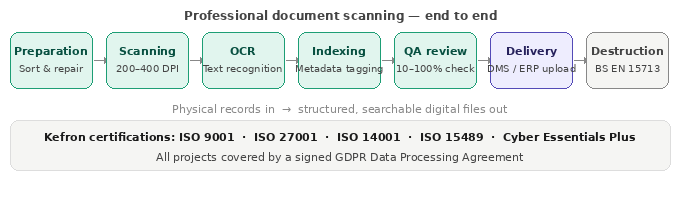
| Stage | What Happens |
|---|---|
| Document preparation | Staple removal, page repair, sorting and batching |
| High-resolution scanning | 200–400 DPI capture depending on document type |
| OCR processing | Text recognition making documents fully searchable |
| Indexing | Metadata tagging by date, type, reference, department |
| Quality assurance | Page-by-page or sample review for accuracy and completeness |
| Digital delivery | Upload to your DMS, SharePoint, ERP or cloud platform |
| Secure destruction | BS EN 15713-compliant shredding with certificate of destruction |
→ Explore Kefron's Document Scanning and Data Capture services
Any organisation that holds significant volumes of paper records can benefit from professional scanning. Workers in the UK spend an estimated one million hours per week searching for misplaced documents — costing businesses £20 million annually. In Ireland, approximately 80% of workers experienced remote or hybrid working during and after the pandemic, with document access cited as one of the most common operational pain points.
Finance teams generate and receive high volumes of invoices, purchase orders, remittances and contracts. Scanning these documents enables faster processing, better audit trails and reduced manual handling across AP workflows.
Legal files contain sensitive, time-critical information. Digitising case files, contracts and correspondence reduces physical storage costs, enables secure remote access and supports e-disclosure obligations.
HR departments hold personnel files spanning decades. With GDPR subject access request obligations and strict retention schedules, searchable digital HR records are a compliance necessity — not an option.
Patient records, referral letters and test results must often be retained for many years under HSE (Ireland) and NHS (UK) guidelines. Scanning and indexing clinical records improves decision-making and eliminates the risk of misplaced files.
Planning applications, case files and historical records are commonly held on paper across councils in the UK and Ireland. Digitisation programmes make these accessible to staff and the public without physical retrieval.
Lease agreements, compliance documents and maintenance records are often scattered across multiple sites. Scanning centralises these records and makes them retrievable from any location.
💡 Expert Insight Many organisations underestimate how much paper they hold until a proper audit is conducted. A document audit — counting volumes by department, format and sensitivity — is always the right first step before scoping any scanning project. It prevents cost surprises and ensures the right service level is matched to the right document type.
Bulk document scanning refers to high-volume projects — typically from several thousand documents up to millions of pages — often involving legacy archives accumulated over years or decades. According to AIIM, organisations that implement document digitisation experience a 30–50% increase in operational efficiency.
1. Document Audit and Scoping A project manager assesses volume, condition, format and sensitivity before any scanning begins. This informs pricing, timelines and handling requirements.
2. Collection and Chain of Custody Documents are collected in tamper-evident boxes with a documented chain of custody log. Every box is tracked from the moment it leaves your premises.
3. Document Preparation Sorting, unfolding, destapling, repairing and batching is often the most time-intensive stage. Preparation quality directly affects scan quality — this is where many low-cost providers cut corners.
4. High-Speed Scanning Industrial equipment — capable of processing thousands of pages per hour — captures documents at the required resolution. Colour, greyscale or black-and-white output is selected based on document type.
5. OCR Processing Optical Character Recognition converts scanned images into fully searchable text. Without OCR, a scanned document is simply a photograph of a page.
6. Indexing Documents are tagged with agreed metadata fields — date, reference number, supplier, department — enabling retrieval by any field relevant to your workflows.
7. Quality Assurance A sample — typically 10–20% — is reviewed for accuracy and completeness. Many providers offer 100% QA for sensitive document sets.
8. Secure Destruction Where originals are no longer required, BS EN 15713-compliant destruction is carried out and a certificate issued.
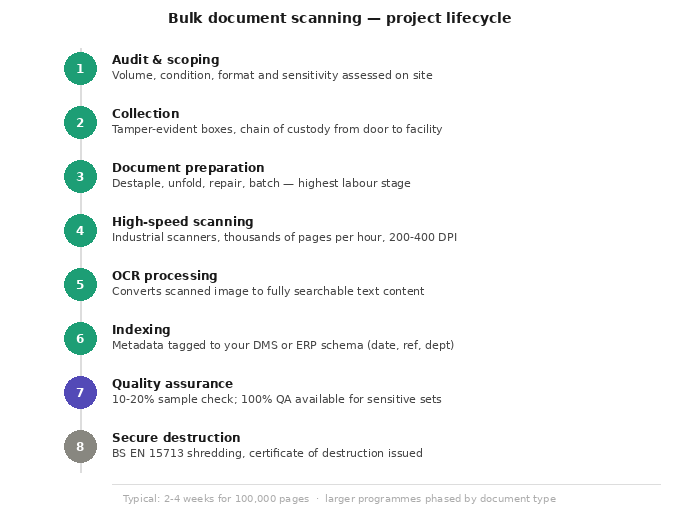
Figure 2: The eight stages of a professionally managed bulk document scanning project.
→ Read our full guide to the commercial document scanning process
When documents contain personal data, financial information or legally privileged content, security is a baseline requirement — not an optional extra.
Under UK GDPR and Ireland's Data Protection Act 2018, any third party processing personal data on your behalf must operate under a signed Data Processing Agreement. The Irish Data Protection Commission has issued over €3.5 billion in fines since 2018, while the ICO can impose penalties of up to £17.5 million or 4% of global annual turnover.
| Accreditation | What It Covers |
|---|---|
| ISO 9001 | Quality Management |
| ISO 27001 | Information Security Management |
| BS EN 15713 | Secure Document Destruction |
| Cyber Essentials Plus (UK) | Baseline IT security controls |
| NSAI Certification (Ireland) | Irish national standards body accreditation |
Kefron holds ISO 9001, ISO 27001, ISO 14001, ISO 15489 and Cyber Essentials Plus certifications — verifiable on request.
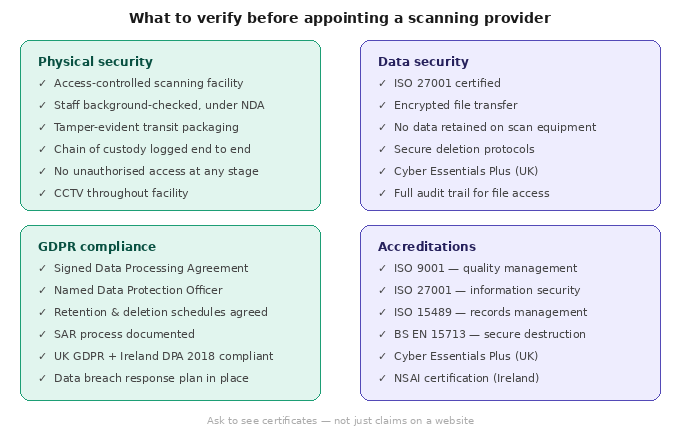
Figure 3: Key security requirements to verify before appointing a document scanning provider.
Most organisations face two challenges: the ongoing flow of new documents and the existing archive — years or decades of paper stored in boxes, filing cabinets or off-site facilities. Archive scanning tackles the backlog so organisations can start with a clean digital slate.
Key considerations for any archive project:
A phased archive scanning programme typically pays for itself within 12–18 months through reduced retrieval time and storage savings alone.
→ Learn about Kefron's secure document storage and records management
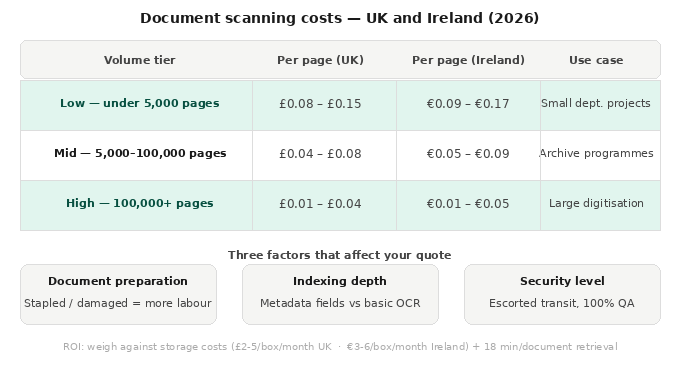
Figure 4: Indicative document scanning costs for businesses in the UK and Ireland (2026).
Document scanning is the conversion process — taking physical paper and producing searchable digital files.
Document management is what happens next — how those files are stored, organised, retrieved, approved and eventually destroyed.
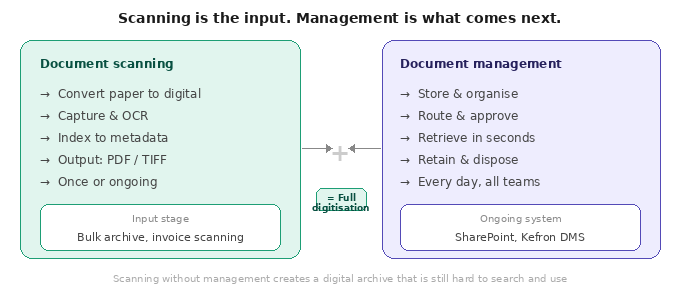
Figure 5: Document scanning and document management work together to deliver a complete digitisation solution.
Scanning without document management simply creates an unstructured digital archive — files that exist digitally but are still hard to find and use. The most effective programmes combine professional scanning with a document management system that integrates with core business applications.
A digital mailroom takes this further — automatically capturing incoming physical and digital mail, classifying it and routing it to the right person or workflow without manual handling.
💡 Expert Insight The organisations that get the most value from document scanning are those that connect it to a business process — not those that simply create a digital archive. When a scanned HR file automatically updates a records management system, or incoming mail is classified and routed on arrival, that is where productivity gains become material and measurable.
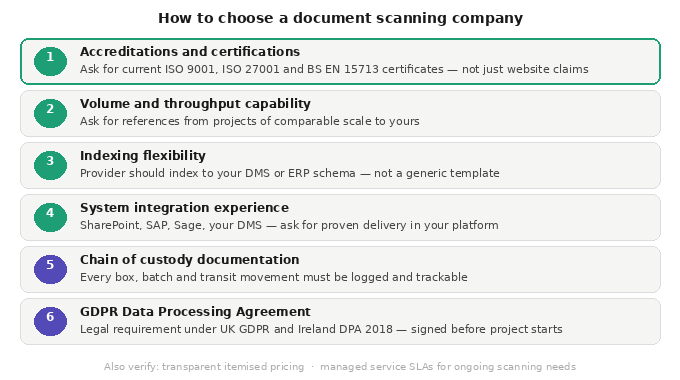
Figure 6: Use this checklist to evaluate document scanning providers before committing to a project.
Accreditations and certifications Ask to see current ISO 9001 and ISO 27001 certificates. For projects involving destruction, BS EN 15713 is essential. In Ireland, look for NSAI-recognised standards.
Volume and throughput capability Ask how many pages per day the facility processes, and for references from projects of comparable scale.
Indexing flexibility A good provider indexes documents against the metadata fields your DMS actually uses — not a generic template.
System integration experience Ask about your specific platform — SharePoint, SAP, Sage or your own DMS. See how Kefron's digitisation service delivers to any target platform.
Chain of custody documentation Every box and transit movement should be logged. If a provider cannot tell you exactly where your documents are at any point, that is a significant risk.
GDPR compliance documentation A signed Data Processing Agreement is a legal requirement under both UK GDPR and Ireland's Data Protection Act 2018.
Transparent, itemised pricing Costs for preparation, scanning, OCR, indexing, QA, delivery and destruction should be itemised separately.
Ongoing managed service capability Choose a provider who can support a managed service model with agreed SLAs if your scanning needs are continuous.
What is document scanning? Document scanning is the process of converting physical paper documents into digital files. Professional document scanning services include document preparation, high-resolution scanning, OCR text recognition, metadata indexing and secure digital delivery — not just image capture.
What is bulk document scanning? Bulk document scanning is a high-volume scanning project — typically from several thousand to millions of pages — usually involving legacy archives. It covers preparation, scanning, indexing, quality assurance and often secure destruction. Learn more about Kefron's bulk scanning service.
How secure is document scanning? A professionally accredited provider will hold ISO 27001 and BS EN 15713 certifications, maintain a documented chain of custody, and operate under a GDPR-compliant Data Processing Agreement.
How much do document scanning services cost in the UK and Ireland? Costs range from £0.01–£0.15 per page (€0.01–€0.17) depending on volume, format, indexing depth and security requirements. Higher volume projects attract lower per-page rates.
What is the difference between document scanning and document management? Document scanning converts paper to digital files. Document management is the system that organises, stores, routes and retrieves those files on an ongoing basis. Both are needed for a complete digitisation solution.
How long does a bulk scanning project take? A 100,000-page project typically takes 2–4 weeks from collection to delivery. Larger archive programmes are phased over months, starting with the most frequently accessed document types.
Are document scanning services GDPR compliant? They should be — but compliance is the provider's responsibility to demonstrate. A signed Data Processing Agreement, ISO 27001 certification and documented data handling processes are the minimum requirements under both UK GDPR and Ireland's Data Protection Act 2018.
What happens to original documents after scanning? Where originals are no longer legally required, BS EN 15713-compliant destruction is provided with a certificate. Where retention is required, secure document storage can be arranged.
Document scanning services are one of the highest-return investments a paper-heavy business can make. The cost of holding, retrieving and managing physical records — in staff time, storage fees and regulatory risk — almost always exceeds the cost of a well-planned digitisation project.
The right scanning partner delivers indexed, searchable, system-integrated documents that reduce the burden on your team from the moment a project completes.
Talk to the Kefron team about your document scanning requirements →