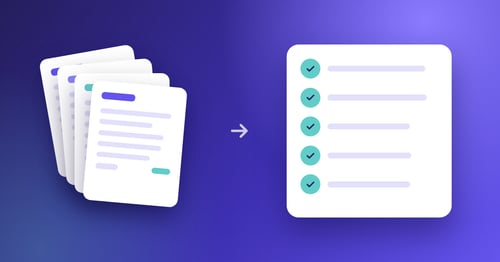
How to Move AP to a Paperless Workflow in 7 Easy Steps (2026)
If your finance team still handles invoices manually, you already know the cost: lost paperwork,...

Tipalti covers a wide range of finance operations, including accounts payable, global payments, procurement, expenses and treasury.
That breadth is useful for some businesses, but it also means there is no single like-for-like Tipalti alternative. The right choice depends on what you actually need to improve: invoice processing, PO matching, supplier payments, procurement, spend management or several of these together.
If you're comparing alternatives to Tipalti, the first step is deciding whether you need a full finance automation suite or a more focused AP solution.
For finance teams primarily evaluating invoice processing, the most relevant Tipalti AP alternatives are likely to be those with deeper AP automation, matching and exception-management capabilities.
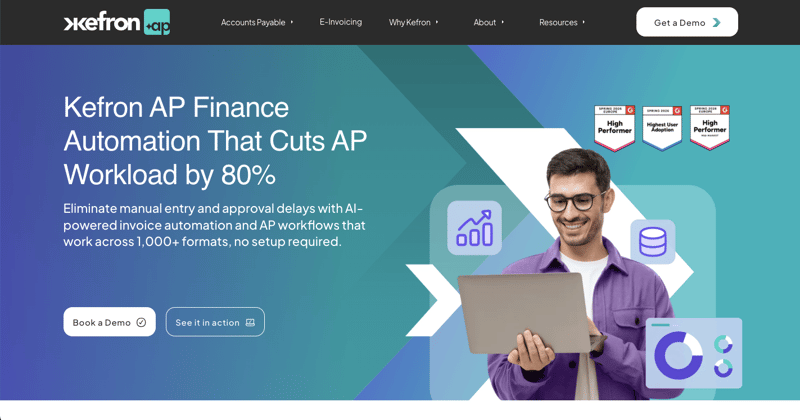
Best for: Finance teams focused on increasing touchless invoice processing while retaining their existing ERP and finance processes.
Kefron AP automates the invoice lifecycle from capture and validation through coding, PO matching, approvals and ERP synchronisation.
One of its key differences is how invoice data is handled when automation is uncertain. Kefron combines AI-powered capture with a Data Assurance Team that can review flagged invoice information before it reaches the customer's AP team. Kefron AP reports 99%+ invoice data accuracy through this model.
The platform also supports automated coding and two-way and three-way matching at line-item level, including comparison against purchase orders and goods received notes.
Kefron AP's current positioning places particular emphasis on touchless processing as a customer-specific performance target. Instead of applying the same automation percentage to every business, Kefron reviews each customer's invoice mix, suppliers, workflows and exceptions, establishes a realistic target and works to improve that rate over time.
Key strengths
Worth shortlisting when: The business case is primarily about reducing manual AP intervention rather than adding global payments, treasury or a broad procurement suite.
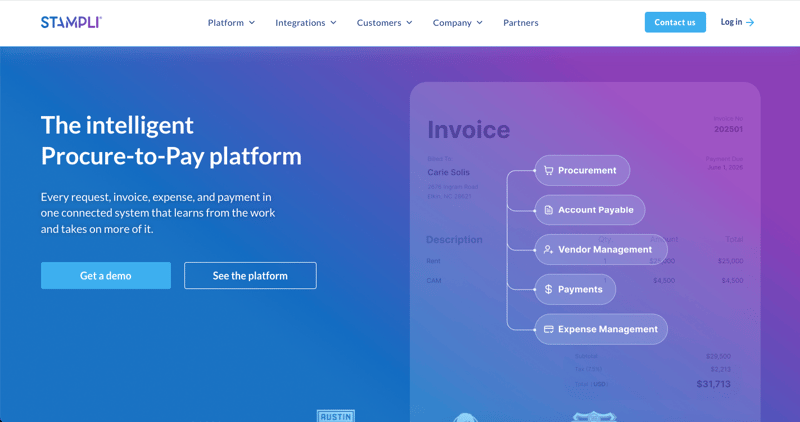
Best for: Connecting AP with procurement, vendor management and payments.
Stampli provides a procure-to-pay platform spanning procurement, accounts payable, vendor management and payments, while maintaining a strong focus on invoice workflows.
Key strengths
Worth shortlisting when: You want AP at the centre of a wider procure-to-pay process rather than as a standalone invoice tool.
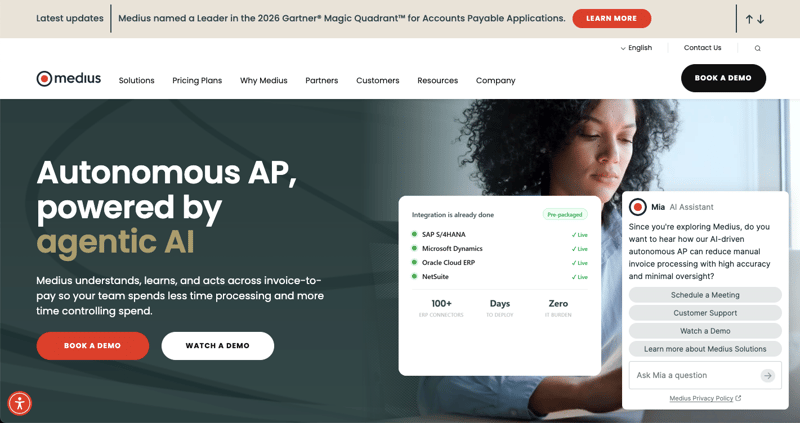
Best for: Larger organisations building an enterprise source-to-pay process.
Medius connects AP automation with procurement, payments, sourcing, contract management and supplier onboarding. It also provides managed ERP connectors for major enterprise systems.
Key strengths
Worth shortlisting when: Accounts payable is one stage of a larger source-to-pay transformation.
Best for: Enterprises prioritising procurement and company-wide spend control.
Coupa takes a wider spend-management approach, connecting procurement and procure-to-pay workflows with AP and other forms of organisational spend.
Key strengths
Worth shortlisting when: The objective extends beyond AP efficiency into purchasing governance and broader spend management.
Best for: Businesses that want AP, AR and spend management within one financial operations platform.
BILL combines Accounts Payable, Accounts Receivable and Spend & Expense under one platform and login.
Key strengths
Worth shortlisting when: Connecting several everyday finance workflows is more important than implementing a specialist enterprise AP system.
Best for: Mid-market businesses automating purchasing, invoice processing and supplier payments.
AvidXchange provides purchase-to-pay automation covering purchase orders, invoice processing and payments. Its AP offering includes invoice matching and integrated two-way and three-way matching.
Key strengths
Worth shortlisting when: You want to automate the flow from purchasing through invoice approval and payment while retaining your accounting system.
Best for: Multinational organisations with significant e-invoicing and invoice-compliance requirements.
Basware combines invoice automation with e-invoicing, matching and compliance capabilities, making it particularly relevant to complex international invoice environments.
Key strengths
Worth shortlisting when: Regulatory invoice requirements across multiple markets are as important as AP workflow automation.
Best for: Finance teams where PO matching creates a large share of AP workload.
Rillion centres on AP automation, including AI-supported invoice capture, coding, approval workflows and two-way or three-way matching between invoices, purchase orders and goods receipts.
Key strengths
Worth shortlisting when: Complex PO invoices and matching exceptions are the main processes you want to automate.
Best for: Cloud-based AP and purchase-to-pay automation.
Yooz combines invoice automation with purchasing and payment workflows. In 2026, it expanded its PO capabilities with AI-driven line-level matching for invoice reconciliation and exception handling.
Key strengths
Worth shortlisting when: You want cloud AP automation with purchasing and detailed matching capabilities.
Kefron also has a dedicated guide comparing Yooz alternatives for teams evaluating that platform more closely.
Best for: Finance teams wanting to automate invoices and purchase orders around an existing accounting platform.
Quadient AP by Beanworks connects with accounting software and supports invoice processing, purchase-order workflows and matching.
Key strengths
Worth shortlisting when: Core AP and PO automation are the priority and you do not require a large enterprise spend suite.
Best for: Businesses already using SAP Concur for travel or expense management.
Concur Invoice covers invoice capture and approval workflows and can connect with ERP, accounting and payment systems. Its natural advantage is the ability to manage invoice-based spending alongside the wider Concur environment.
Key strengths
Worth shortlisting when: Your organisation already operates within SAP Concur and wants AP to sit alongside existing travel and expense processes.
Tipalti is not only an invoice-processing platform. Its product suite can extend from invoice capture and AP through supplier payments, procurement, expenses and treasury, with global payment coverage across more than 200 countries and territories.
That creates several different reasons to evaluate alternatives.
If you're comparing AP automation software primarily to reduce invoice-processing work, prioritise:
Look more closely at:
In this scenario, an AP platform without comparable payment infrastructure may not be a complete replacement.
Evaluate:
This pushes the shortlist toward broader procure-to-pay or spend-management platforms.
Platform breadth becomes more valuable when the goal is consolidation rather than improving one isolated workflow.
The tradeoff is that more functionality does not automatically mean more value. The platform still needs to solve the operational bottlenecks that justified the investment in the first place.
Most established AP automation software can demonstrate invoice capture, approvals and ERP integration.
The differences become clearer when you test what happens outside the ideal workflow.
Use a representative sample rather than vendor-provided examples.
Include:
Multi-page invoices Large numbers of line items Unfamiliar supplier layouts Credits Poor-quality documents PO and non-PO invoices
Measure how much human intervention is required before the invoice is ready for the next stage.
Measure how much human intervention is required before the invoice is ready for the next stage.
Ask the provider to demonstrate scenarios such as:
The question is not just whether three-way matching exists. It is what happens when the three documents do not agree.
A supported ERP name does not tell you how deep the integration goes.
Confirm:
This is particularly important for finance teams trying to improve AP without changing their ERP.
Document the payment functionality the business actually needs.
For example, a multinational operation may need cross-border supplier payments, currency support and onboarding controls. Another organisation may already have a reliable ERP-to-bank payment process and only need approved, accurate invoice data to reach it.
Removing functionality you do not require can change which alternatives deserve to be shortlisted.
Automation performance can change as suppliers, workflows and invoice patterns change.
Compare how vendors handle:
For Kefron, this ongoing element is part of its touchless-processing approach: the target is defined around the customer's operation and then reviewed and improved over time.
The strongest alternatives to Tipalti are not necessarily the platforms with the closest feature lists.
If your main objective is processing more invoices without additional AP work, prioritise invoice accuracy, touchless processing, matching, exception handling and workflow automation.
If the objective is controlling purchasing before the invoice arrives, put procurement and spend-management platforms higher on the list.
If the problem is paying a large international supplier base, global payment infrastructure deserves greater weight.
If several of these problems need to be solved together, a broader platform may justify the additional scope.
Write down the three outcomes the project must deliver before vendor demos begin. Score every platform against the same outcomes. Features that do not contribute to those outcomes should have less influence on the final decision.
A good demonstration should give you enough information to understand how the platform would operate with your real AP process.
Ask:
The answers make it easier to distinguish a platform that contains the required features from one that can actually reduce the workload behind your current process.
A useful Tipalti comparison starts with the finance process that is creating the problem.
If the priority is global payments or procurement, evaluate platforms built around those functions. If AP teams are still correcting invoice data, resolving PO exceptions and chasing approvals, give more weight to the depth of invoice automation and the amount of manual work left after implementation.
Shortlist the platforms that match those priorities, then test them against the same invoices, exceptions and ERP requirements.
The goal is not to find the platform with the broadest feature list. It is to choose the one that improves the finance process you actually need to change. If Kefron AP seems like something that could help you along with this, feel free to contact us.
Which Tipalti alternatives are more focused on AP automation?
Kefron AP and Rillion are among the more AP-focused options in this comparison. Other platforms, including Medius, Coupa and Stampli, extend further into procurement or broader spend workflows. The appropriate scope depends on whether accounts payable is the main project or one part of a wider transformation.
Which alternatives to Tipalti support procurement?
Stampli, Medius, Coupa and Yooz all extend beyond invoice processing into procurement or purchase-to-pay functionality. The depth varies, so compare the specific purchasing, supplier and approval workflows required by your organisation.
Is Tipalti mainly an AP automation platform?
Tipalti includes AP automation, but its current platform is broader than accounts payable alone. It also offers global payments, procurement, expenses and treasury capabilities. Businesses therefore need to decide whether they want to replace only the AP component or a wider set of finance functions.
Do all Tipalti alternatives include supplier payments?
No. Payment capabilities and geographic coverage vary significantly between platforms. Some alternatives include payment workflows as part of a wider suite, while AP-focused platforms may integrate approved invoice data with an existing ERP or payment process. Confirm country, currency, method and reconciliation requirements directly with each shortlisted provider.
Can I use an AP automation platform without replacing my ERP?
Yes. Many AP platforms are designed to integrate with existing ERP or accounting systems. The important question is how deeply the systems connect. Test the exchange of supplier data, purchase orders, goods receipts, coding dimensions, invoice records and status updates rather than relying only on an ERP logo on an integration page.