
Putting Finance Transformation Into Practice: Highlights From the FISCAL EMPOWER Partner Panel
On Friday 25th September, the FISCAL EMPOWER partner panel brought together leading voices from...

Despite years of investment in digital transformation, manual invoice processing remains a challenge for many finance teams.
To better understand the state of accounts payable (AP) operations, Kefron partnered with Censuswide to survey 200 UK finance professionals. The findings reveal that while automation adoption continues to grow, many organisations still struggle with manual invoice data entry, approval delays, rising processing costs, and compliance pressures.
As invoice volumes increase and finance teams are expected to do more with fewer resources, these challenges are becoming increasingly difficult to ignore.
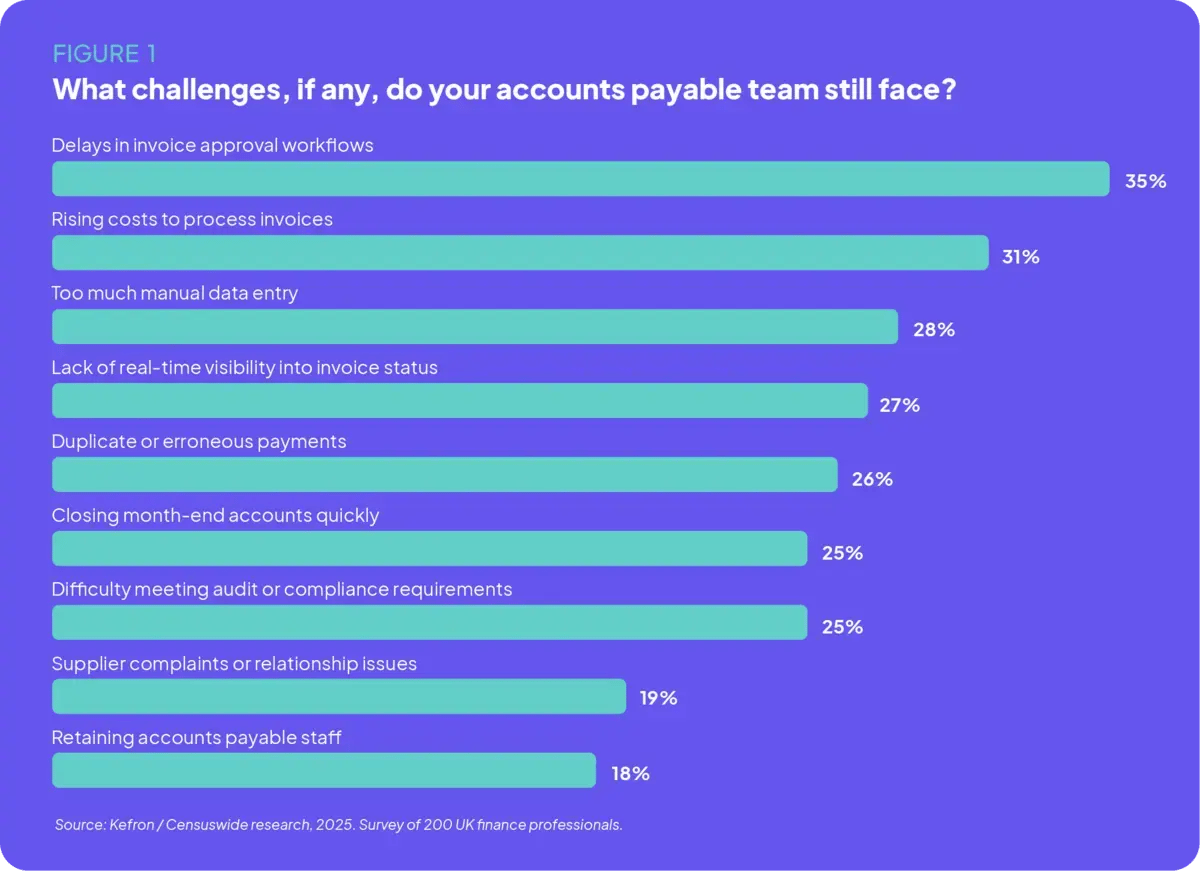
The research highlights the ongoing challenges facing finance teams.
The most common issue reported was delays in invoice approval workflows (35%), followed by rising invoice processing costs (31%). However, one of the most significant findings was that 28% of respondents identified manual invoice data entry as a major challenge.
For many organisations, finance teams continue to spend valuable time manually entering invoice information, validating supplier data, and correcting errors. These repetitive tasks not only reduce productivity but also increase the risk of mistakes, duplicate payments, and approval delays.
According to the Institute of Finance & Management (IOFM), manual invoice processing remains one of the biggest barriers to AP efficiency, particularly as invoice volumes increase.
Businesses looking to reduce manual effort are increasingly turning to invoice automation software that captures, extracts, and validates invoice data automatically.
Learn more about Kefron's Invoice Automation solution.
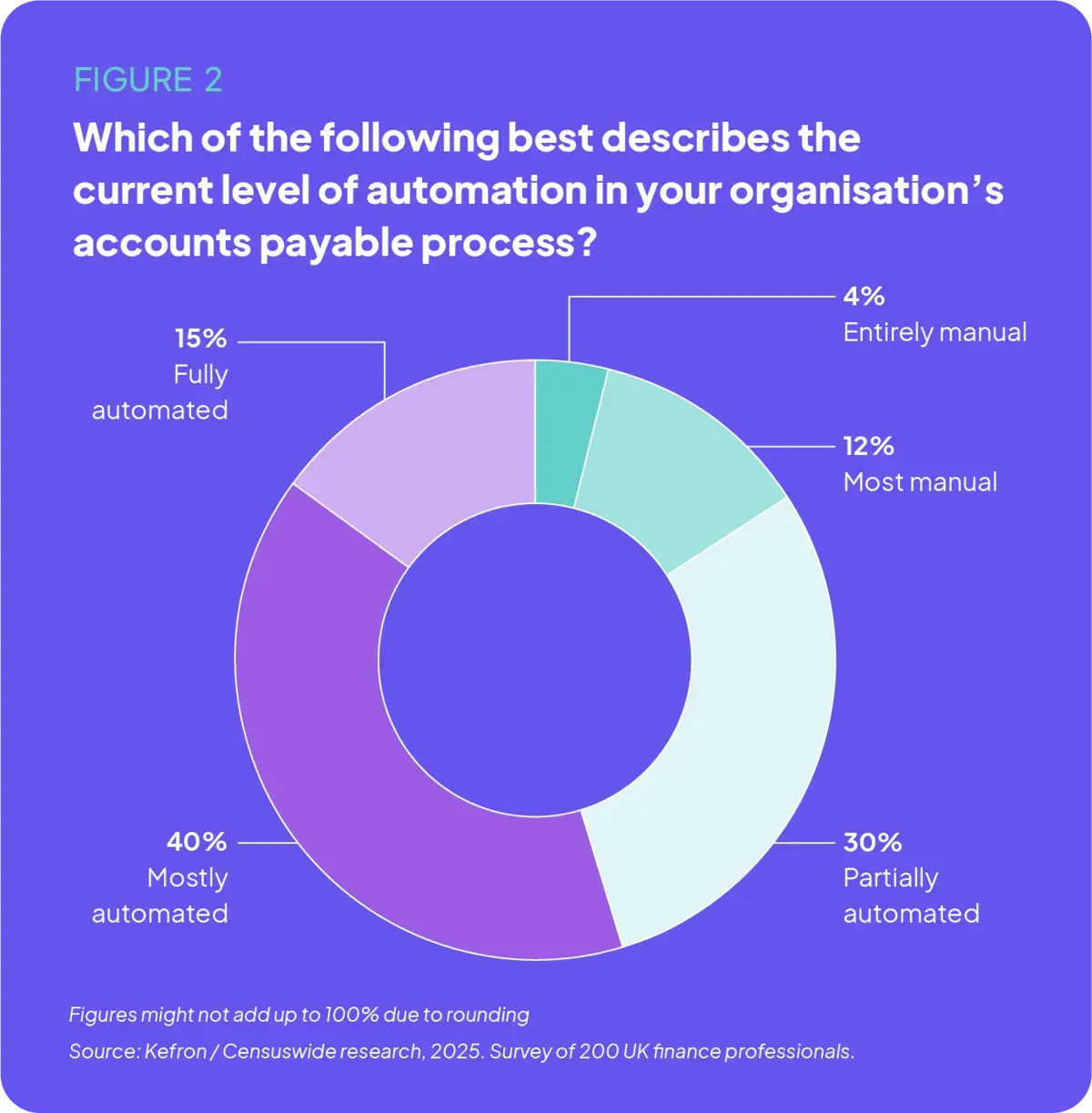
While automation adoption is increasing, the research suggests many organisations still have work to do.
Only 15% of respondents described their accounts payable process as fully automated.
Meanwhile:
This indicates that many finance teams continue to rely on some level of manual invoice processing, data entry, and approval activity.
The challenge for many organisations is not whether to automate, but how to remove the remaining manual bottlenecks that prevent true end-to-end automation.
According to ACCA, finance transformation initiatives increasingly focus on eliminating repetitive transactional activities and enabling finance teams to focus on strategic decision-making.
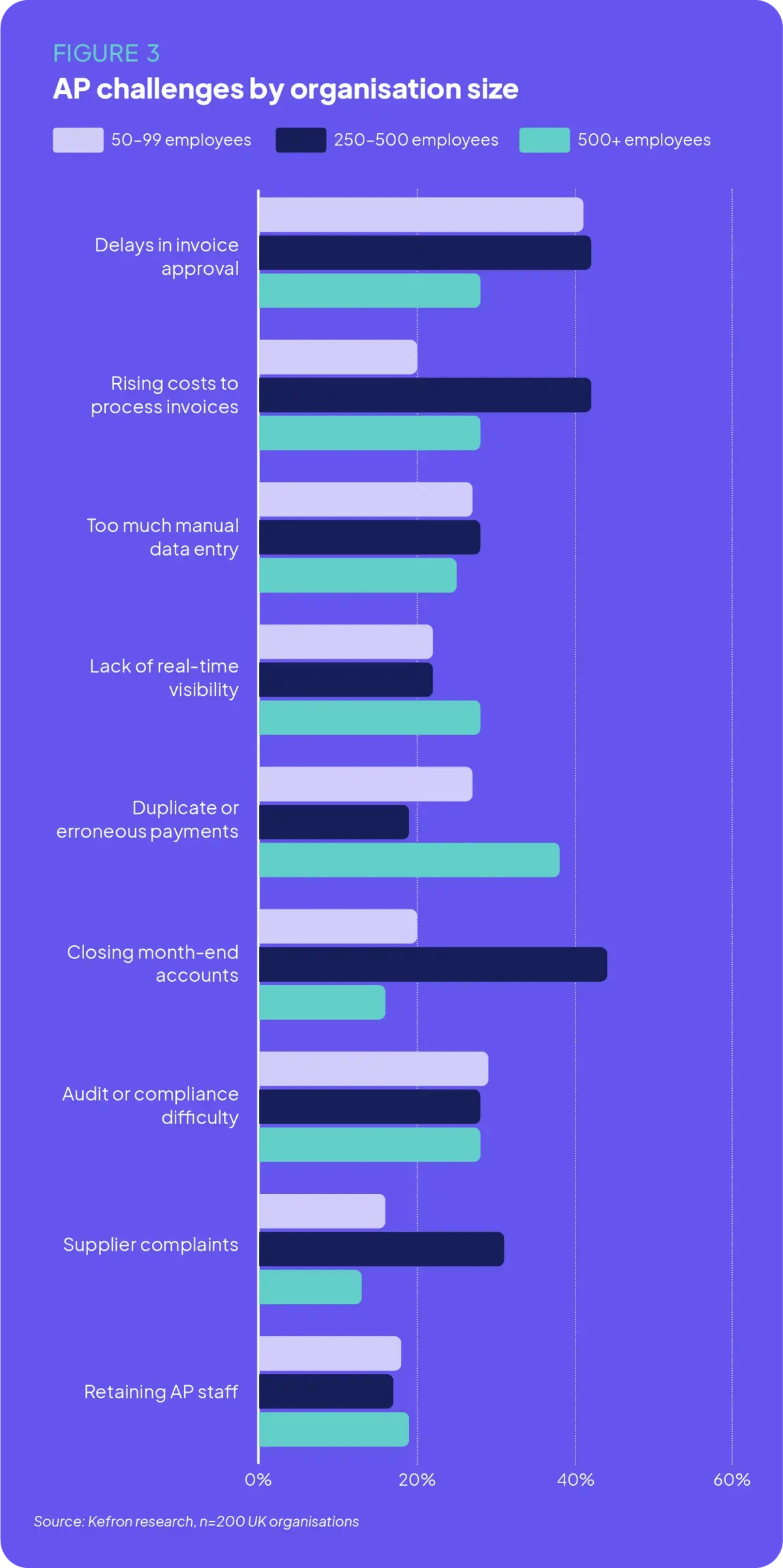
The findings also reveal that AP challenges vary depending on organisation size.
Organisations with 250–500 employees reported the highest levels of invoice approval delays and month-end closing pressures.
Larger organisations with 500+ employees were more likely to experience:
Interestingly, manual invoice data entry remained a consistent challenge across all organisation sizes, demonstrating that even organisations with some level of automation still struggle with manual processes.
This reinforces the need for intelligent invoice processing solutions capable of handling increasing invoice volumes without increasing administrative workloads.
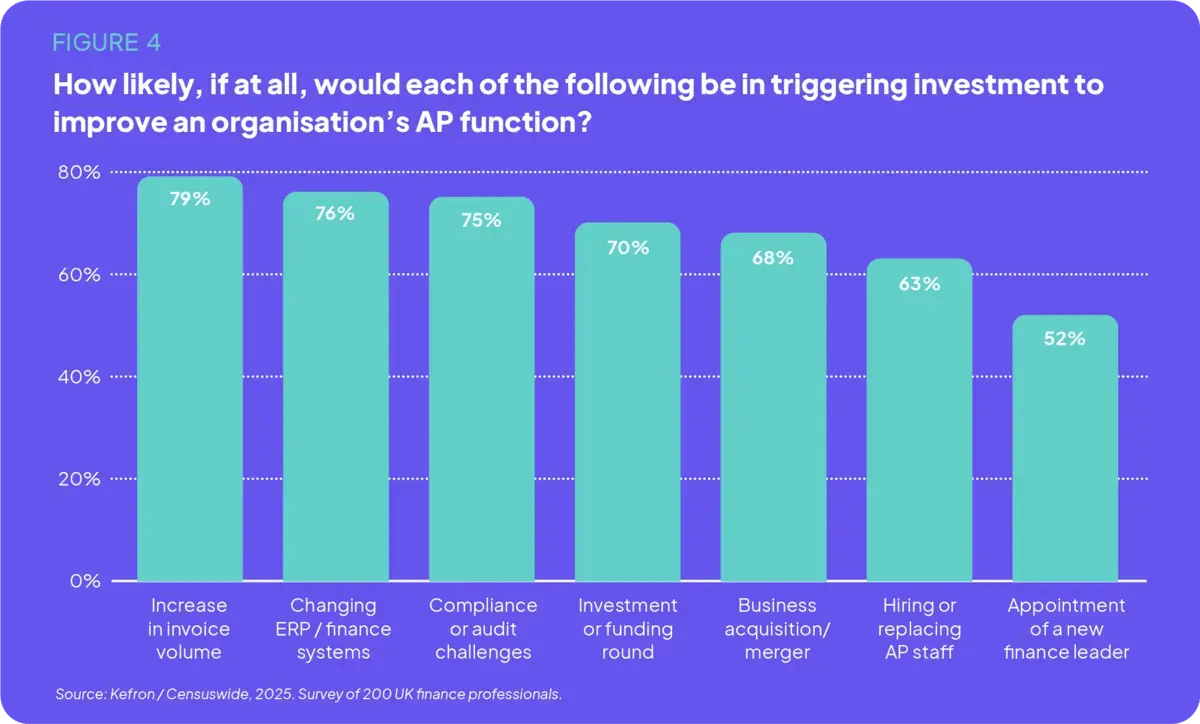
The research reveals several common triggers that encourage organisations to invest in AP automation.
The top drivers include:
| Trigger | Percentage |
|---|---|
| Increase in invoice volume | 79% |
| ERP or finance system changes | 76% |
| Compliance or audit challenges | 75% |
| New funding or investment | 70% |
| Business acquisition or merger | 68% |
These findings suggest that many organisations reach a tipping point where manual invoice data entry and approval processes can no longer support business growth.
As invoice volumes increase, finance teams need systems that can process invoices efficiently, maintain accuracy, and provide visibility throughout the approval process.
This is where accounts payable automation becomes critical.
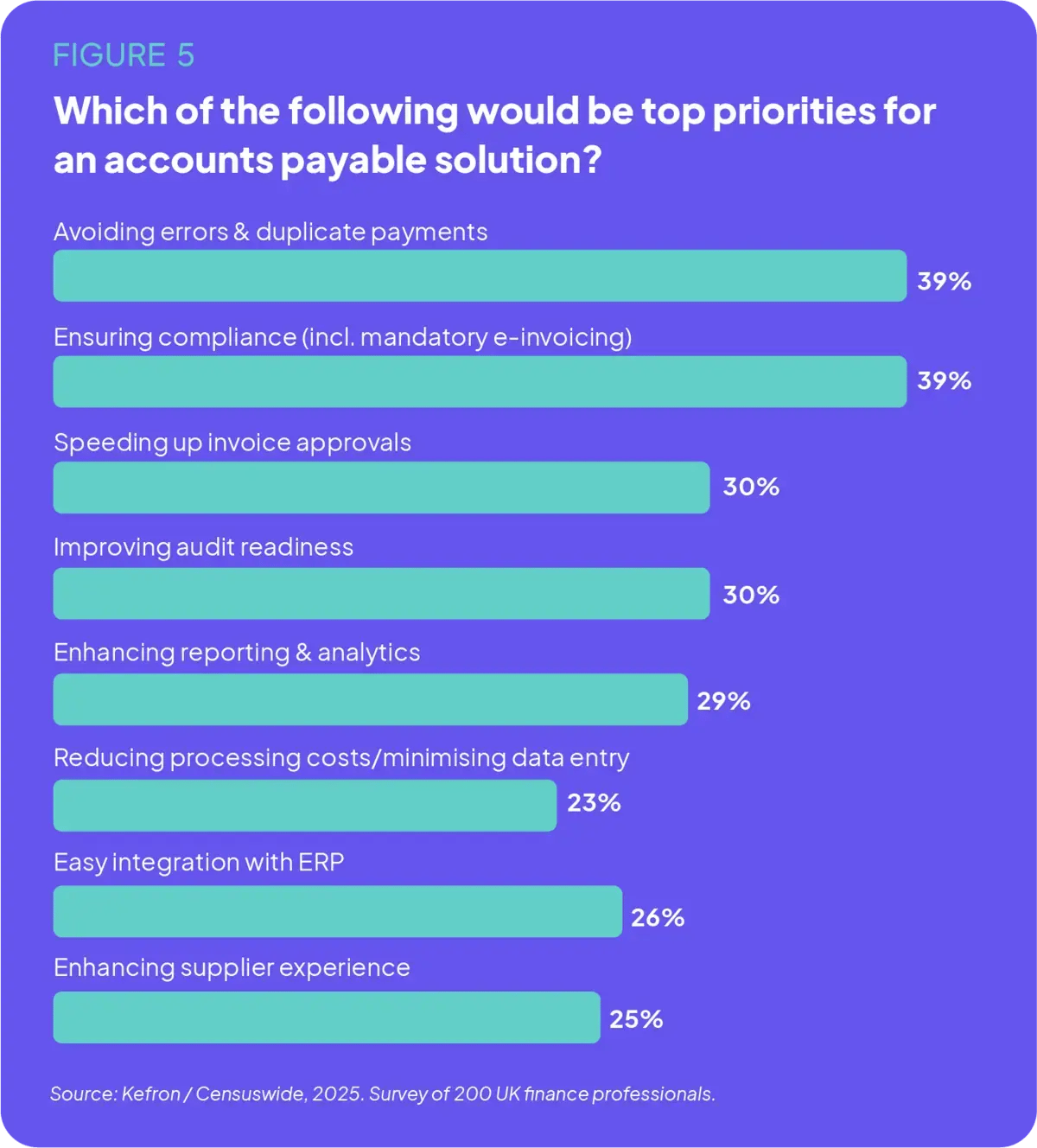
When evaluating accounts payable solutions, finance leaders are focused on outcomes rather than simply reducing administrative work.
The top priorities identified in the survey were:
| Priority | Percentage |
|---|---|
| Avoiding errors and duplicate payments | 39% |
| Compliance and e-invoicing readiness | 39% |
| Speeding up invoice approvals | 30% |
| Improving audit readiness | 30% |
| Enhancing reporting and analytics | 29% |
Interestingly, reducing manual data entry was not the highest-ranked priority.
Instead, organisations are increasingly focused on the broader benefits automation delivers, including compliance, visibility, financial control, and risk reduction.
This aligns with wider finance industry trends identified by organisations such as CIMA, which highlight the growing role of automation in supporting governance and decision-making.
Modern accounts payable solutions are no longer limited to basic OCR technology.
Today's leading platforms use artificial intelligence to automatically:
This significantly reduces manual intervention while improving accuracy and visibility.
For organisations looking to eliminate manual invoice processing, AI invoice processing can provide a practical route to greater efficiency and scalability.
For organisations managing high volumes of purchase orders, PO matching automation can further reduce manual effort and improve accuracy:
The research clearly shows that finance teams are making progress on automation, but manual invoice processing remains a significant challenge.
Invoice approval delays, rising processing costs, compliance pressures, and manual invoice data entry continue to impact organisations across all sectors and sizes.
As invoice volumes increase and finance teams face growing demands, automation is becoming less of a competitive advantage and more of a business necessity.
Organisations that successfully eliminate manual invoice data entry can improve efficiency, strengthen compliance, reduce risk, and create more capacity for strategic financial activities.
The question is no longer whether invoice data entry can be automated.
It's whether organisations can afford not to automate it.