Three-Way Matching Automation: Tolerances, Exceptions & Setup (2027)
Three-way matching is the accounts payable control that compares every supplier invoice against its...
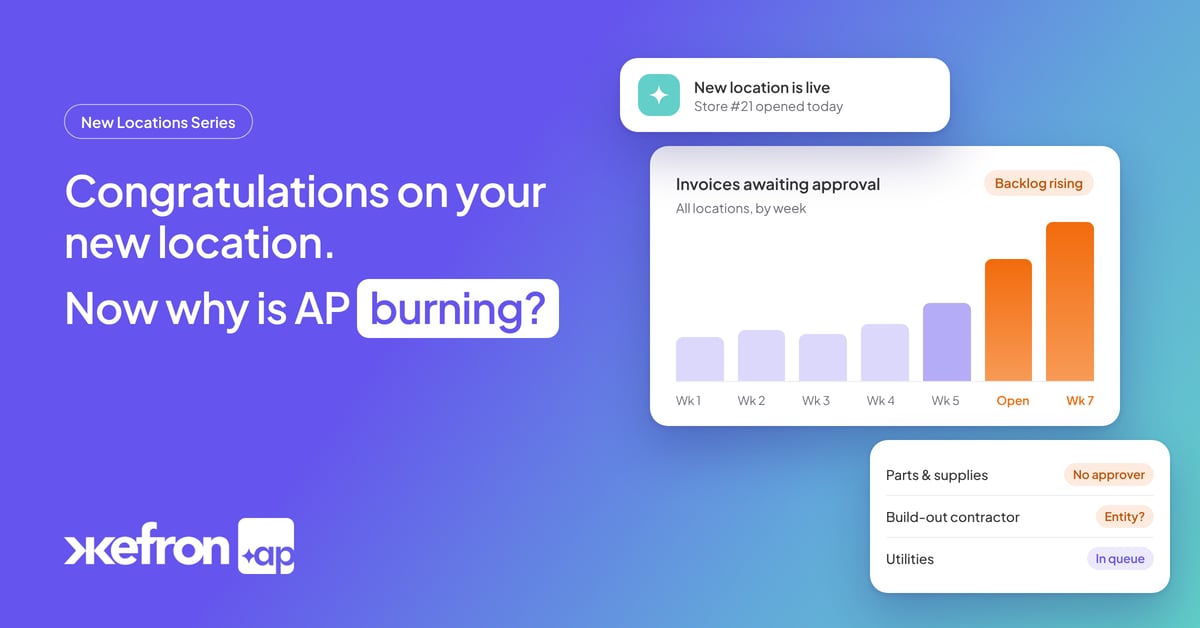
The ribbon is cut, the shelves are stocked and the first customers are through the door. Back at headquarters, the invoices are piling up.
When a new location opens, AP strains because each store adds vendors, approvers and cost centers, and often a new legal entity. The central team usually stays the same size. Multi-entity accounts payable automation fixes this. It captures every invoice, codes it to the right entity and location, and routes it to the right approver automatically. This article covers why AP breaks during expansion and how it shows up whether you run restaurants, car washes, HVAC branches or grocery stores. It also covers what to put in place before your next opening.
Multi-entity accounts payable (AP) automation, also called multi-entity invoice automation, is software that captures, codes, approves and posts vendor invoices across several legal entities or locations from one central platform. Each invoice goes to the correct company, store and approver without anyone rekeying it.
Probably both. Your operations team counts locations: stores, shops, doors. Your finance team counts entities: the separate companies, LLCs or cost centers each location reports into.
The two grow together. A franchise group may set up a new LLC for every store. A tire dealer that buys a 12-shop competitor inherits a new entity, plus 12 locations that need their own reporting. A grocery chain may keep all its stores in one entity but still needs every invoice tagged to the right store's P&L.
If any of these sound familiar, you have a multi-entity AP problem, whatever you call your business:
Kefron AP combines AI-powered capture with human validation for 99% data accuracy, and it integrates with your existing ERP and POS systems. See how Kefron AP automation works.
Expansion is back on the agenda. Aldi plans to open more than 180 US stores in 2026 across 31 states. Food Lion is opening 10 stores this year, after one net new store in each of the two years before, and says this builds momentum for 2027. Restaurant groups, car wash chains, home services companies and auto shops are growing through acquisitions as well as new builds.
Each opening gets a launch plan for staffing, stock and marketing. AP rarely gets one. Here is where it shows up.
A new store generates invoices from day one: build-out contractors, utilities, opening stock, equipment leases, signage, local services. Revenue takes months to ramp. The AP team feels the opening long before the P&L does.
New regions mean new local vendors to onboard, verify and pay. Each one is a new invoice format, a new set of payment terms and a new chance of fraud from fake bank details.
Who approves a $4,000 refrigeration repair at store 31? The store manager, the regional manager or facilities? When that rule lives in someone's head or inbox, invoices wait. Late invoices mean missed early-payment discounts and frustrated vendors.
One invoice coded to the wrong entity or store skews two P&Ls. Multiply that across dozens of locations and month-end close becomes a reconciliation project. Intercompany charges make it worse.
In manual AP, the only lever is headcount. Every new site means more keying, more chasing and more overtime, until the next hire. That is the "burning" in the headline: growth is working, and the back office is absorbing the cost.
[Image: mid-article. File: new-location-ap-pressure-points.png. Alt text: "Diagram showing how a new store location adds invoices, vendors, approvers and entity coding to a central AP team." Caption: "Figure 1: Where one new location adds work for accounts payable."]
Restaurants, car washes, HVAC branches, auto shops and clinics all run into the same AP problem when they expand. What changes is the mix of invoices each new site adds.
|
If you run... |
Each new location adds... |
|---|---|
|
Restaurants and franchise groups |
Daily food and beverage deliveries, equipment repairs and local services |
|
Auto repair, tire and collision shops |
Parts and tire invoices from many distributors that need to match POS repair orders |
|
Car washes |
Chemicals, equipment maintenance, utilities and site costs |
|
HVAC, plumbing and home services |
Equipment and parts vendors by branch, fleet costs and subcontractors |
|
Grocery and convenience stores |
Direct-store deliveries and PO-heavy invoices with price and quantity differences |
|
Healthcare, dental and vet clinics |
Medical supplies, lab services and equipment leases |
|
Gyms, hotels and childcare centers |
Facilities, cleaning, utilities and local vendors |
The invoices differ, but the fix doesn't. Restaurant accounts payable and retail AP automation both come down to one central process with the right rules for each site.
How you grow matters as much as what you sell.
New builds bring a burst of one-time invoices: build-out, equipment, signage and opening stock. Then come the recurring vendors. Each site needs its own cost center and approver from day one.
An acquired business arrives with its own entity, its own vendors and its own way of doing AP. The faster it moves onto the group's process, the sooner the CFO can trust its numbers.
Many multi-unit operators set up a separate company for each location. That means separate books, separate approvals and intercompany charges, which is multi-entity AP in its purest form.
Gills Point S Tire & Auto Service's Finance Transformation Manager said Kefron AP "cut the time to process invoices from days to just a few hours." Roadside retailer Applegreen uses Kefron AP to automate AP across 193 retail sites in Ireland, the UK and the US. For a closer look at specific sectors, see Kefron AP for retail and tire and auto service providers.
If your growth plan counts new sites, it is an AP plan too.
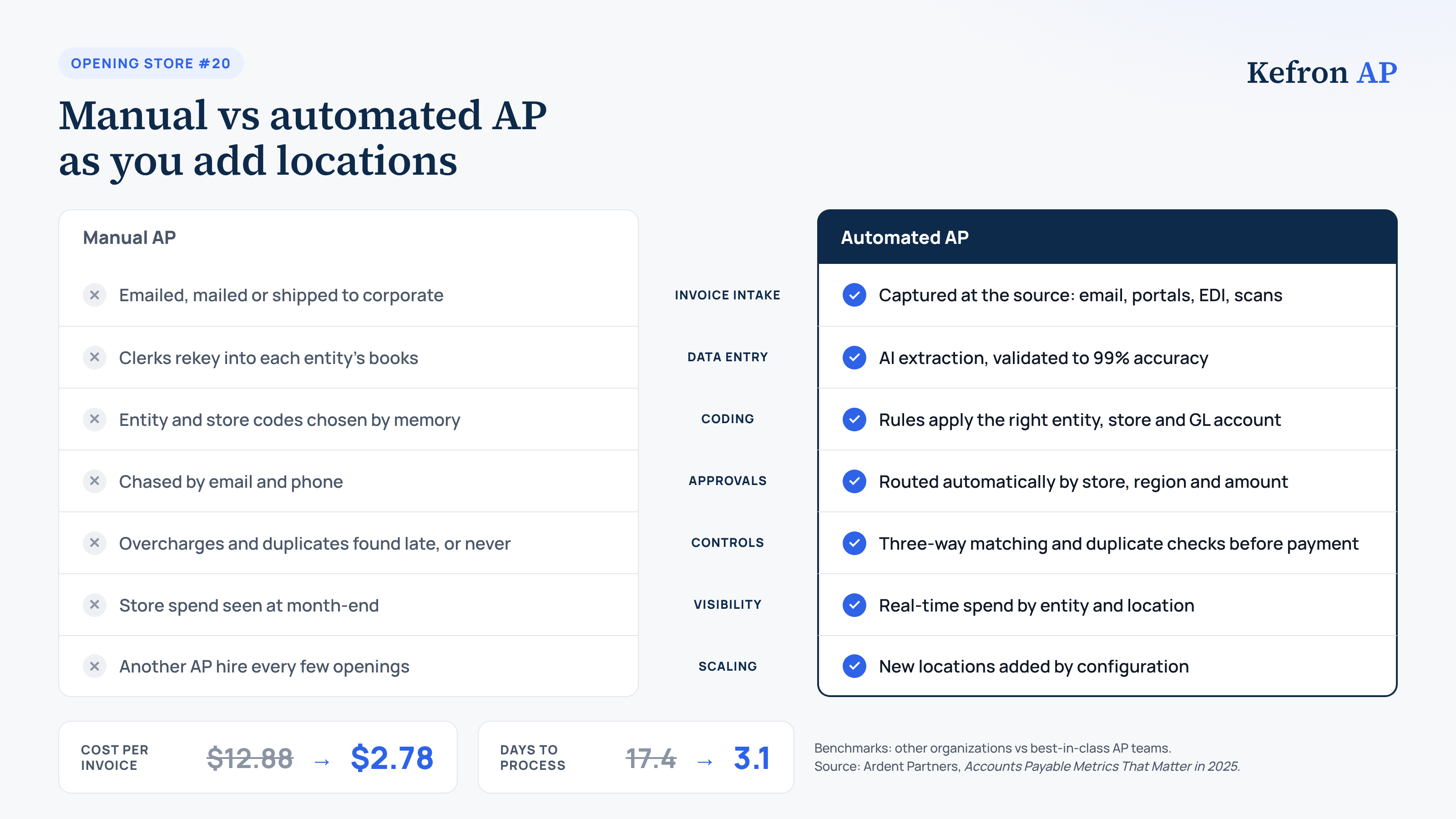
The main benefit is that AP capacity stops depending on headcount. According to Ardent Partners' Accounts Payable Metrics that Matter in 2026, best-in-class AP teams process an invoice for $2.67 and approve it in 4.1 days. Other organizations pay $12.50 and take 15.4 days.
|
Opening store 20 with manual AP |
Opening store 20 with automated AP |
|---|---|
|
Invoices emailed, mailed or shipped overnight to corporate |
Invoices captured at the source from email, portals, EDI and scans |
|
Clerks rekey data into each entity's books |
AI extracts the data, validated to 99% accuracy |
|
Entity and store codes chosen by memory |
Coding rules apply the right entity, store and GL account |
|
Approvals chased by email and phone |
Automatic routing by store, region and amount |
|
Overcharges and duplicates found late, or never |
Three-way matching and duplicate checks before payment |
|
Store spend visible at month-end |
Real-time spend by entity and location |
|
Another AP hire every few openings |
New locations added by configuration |
The gap adds up quickly. At 3,000 invoices a month, the Ardent cost-per-invoice benchmarks put processing at about $450,000 a year for most teams, against $96,120 for a best-in-class team. That is a difference of around $353,900. Use the invoice processing calculator to run your own numbers.
Routing by rule removes the "who approves this?" delay. Vendors get paid on time, and you can capture early-payment discounts more often.
The CFO can see committed spend for every store and entity before the month closes, not after. That is especially useful in a new store's first year, when costs are less predictable.
Duplicate detection, vendor bank account checks and a full audit trail are standard on every invoice, from store 1 to store 100.
Three-way PO matching also catches price and quantity differences between the invoice, the order and what each site received, before you pay.
A new location or acquired group becomes a new set of rules on an existing platform, so it can follow the group's process from day one.
Add these to the launch plan for every new store, alongside staffing and stock:
With multi-entity invoice automation, steps 1, 2 and 6 become rules you set once and reuse for every opening.
It is software that captures, codes, approves and posts vendor invoices across several legal entities or locations from one platform. Each invoice is assigned to the correct entity, store and approver automatically.
Multi-location means invoices come from many sites. Multi-entity means they belong to separate companies or ledgers. Most growing chains have both, and their AP process needs to handle both.
Run every entity through one AP process. Give each entity and location its own codes and approvers, set the coding and routing rules once, and post approved invoices to each entity's books in your ERP. That keeps multi-entity accounting clean at month-end, however many sites you add.
It turns each new store into a configuration step: codes, approvers and rules. The AP team doesn't have to absorb a new manual workload, so invoice volume can grow without adding staff at the same rate.
Yes. Kefron AP integrates with leading ERP systems and with POS data, so invoices post to the right entity and match what each store recorded. See ERP integrations.
It depends on the number of entities, ERP connections and approval rules. Gills Point S Tire & Auto brought 50 locations live in under six weeks.
No. It is most valuable before AP becomes a bottleneck, which is when approval routing and entity coding start to outgrow spreadsheets and email. Fixing it at store 10 is far easier than at store 30.
A new location is a sign the strategy is working. AP shouldn't be the part of the business that pays for it. Multi-entity invoice automation lets your finance team handle store 20, 50 or 200 with the same process and accuracy as store one. It also gives the CFO a live view of spend by entity and location.
Planning your 2027 openings? Book a Kefron AP demo to see how new locations and entities plug into one AP process. Or build the case internally with our AP automation business case guide.