

AP Automation for Tire Dealerships: 71% Touch-Free
AP automation for tire dealerships uses AI to capture supplier invoices, match them line by line to...
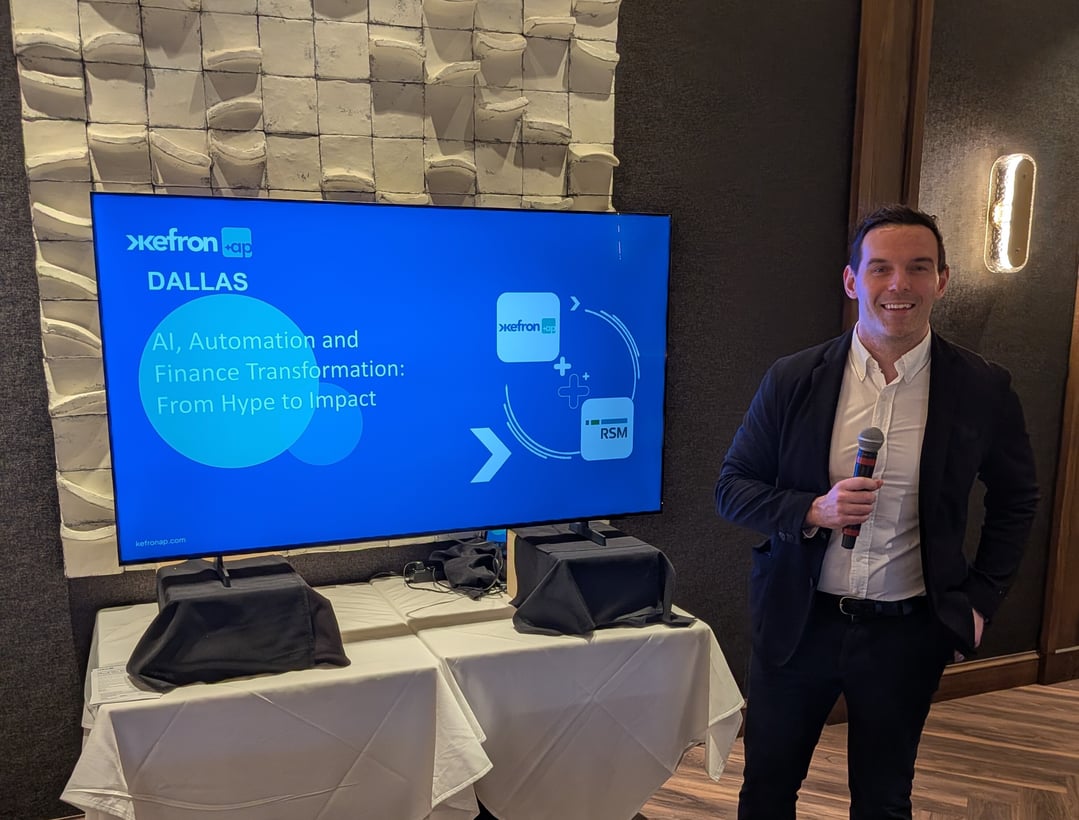
Last week we hosted AI, Automation and Finance Transformation: From Hype to Impact in Dallas with RSM. This article shares what finance leaders told us, what the latest research says, how to connect AI to finance systems safely, and how to build an AI business case that gets signed off.
Before the event we surveyed attendees. 85% said they want practical AI adoption strategies. Yet 70% rated their own AI adoption at just 1 or 2 out of 5. Accounts payable and month-end reconciliations topped the list of most manual finance processes.
That gap between ambition and adoption shaped the narrative throughout our event. Here is what we heard, how it lines up with the latest research, and what we think finance leaders should do next.

Our Dallas room is not unusual. Across the market, almost every finance team is using AI in some form, but far fewer can point to real business value.
Gartner's message to CFOs was blunt: counting pilots and tools rolled out shows activity, not impact. That matches exactly what we heard in Dallas.
When we asked why adoption scores were so low, the answers were rarely about the technology itself. Three themes came up.
Governance. Many leaders want to move but don't yet have clear rules on which tools are approved, what data can be used and who signs off. Without that, AI stays stuck at the experiment stage.
No champion. In most teams, nobody owns AI adoption. It sits between finance and IT, and without a named person driving it, initiatives stall.
"We need AI ideas" instead of a plan. Several teams are collecting AI ideas rather than starting from a problem. A list of possible use cases is not a strategy.
Conversational intelligence is the ability to ask your finance systems a question in plain English and get back the relevant data right away, instead of waiting for a pre-built report. It was the topic that sparked the most discussion in Dallas.
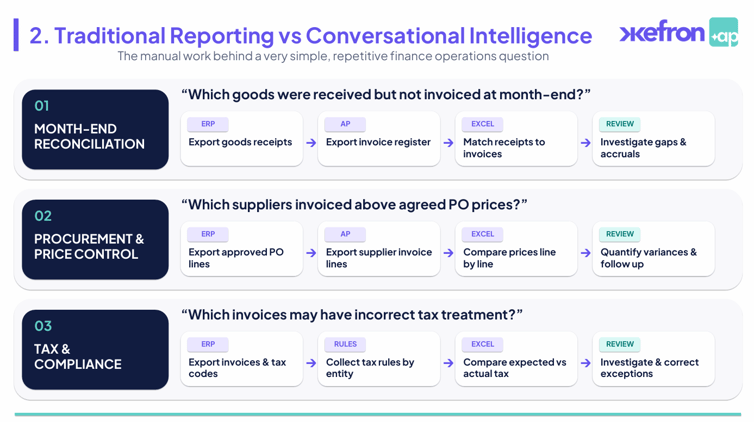
Traditional reporting gives you the reports someone built in advance. They rarely answer the question you have today. A new question usually means exporting from the ERP, exporting from AP, matching in Excel and then investigating the gaps.
Conversational intelligence turns that around. You prompt your systems in plain English and get back the data that matters right now:
The AI draws on connected data such as the vendor master, PO pricing, goods receipts and AP invoices, with the ERP at the core, and returns the answer in minutes instead of days.
What we heard: plenty of leaders are already doing a version of this, often with a general-purpose assistant such as Claude bolted onto their systems. It's useful for ad hoc questions. But it isn't yet part of the everyday process for specific functions. The value comes when conversational intelligence sits inside the workflow, so the AP team asks and acts in the same place, rather than in a separate tool on the side.
One of the biggest surprises of the day was how many finance leaders have already connected AI assistants directly to their finance systems. That raised an obvious question in the room: is that safe?
The honest answer is that it depends on how it's done. Connecting an AI tool to your ERP or AP data is not risky in itself. Doing it without controls is. The questions to ask:
Kurt Meier from RSM shared how RSM approaches this internally within a closed, tightly secured environment. That's the model to aim for. Give people powerful tools inside approved guardrails, so they don't go around them.
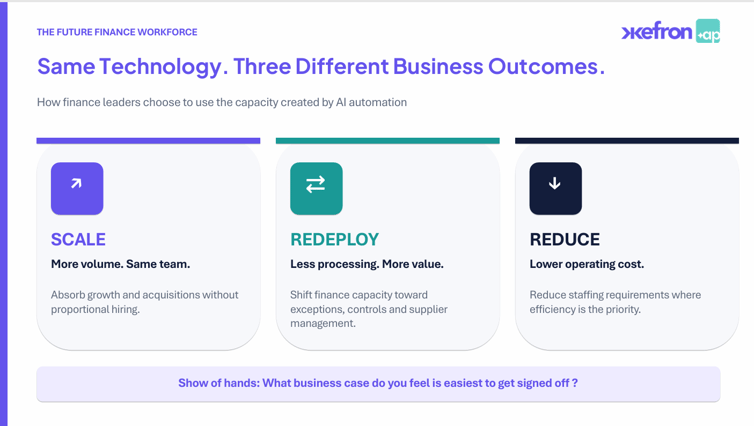
We asked the room which AI business case is easiest to get signed off: scale (more volume, same team), redeploy (less processing, more value) or reduce (lower operating cost). The answer was clear. Redeploy won by a distance, with real interest in the cost savings that come with it.
Interestingly, despite recent headlines about AI-linked layoffs at large tech companies, headcount anxiety barely came up. Finance leaders want to show value. What they're less sure about is where to start.
Our view: the business case comes from the measurable value you create with the time that you save rather than just saving time itself. An example we shared from one of our clients on the day: 78% of 5,000 monthly stock invoices are now processed touch-free, returning around 325 hours a month. Purchase ledger clerks have moved into analyst roles, identifying savings and negotiating early-payment discounts.
Most AI business cases in finance are written around hours saved. The ones that get approved, and deliver, name what that time will be used for: capturing early-payment discounts, tighter credit control, or supporting acquisitions without new hires. Time saved is the input. Measurable value is the outcome.
"We need to use AI" won't get signed off. Instead:
If the conversations in Dallas had one lesson, it's that the tools are ready before most finance teams are. Three steps close the gap:
We'd love to hear how you're applying AI in your finance function, whether you're already piloting or still working out where to start. Book a 30-minute call with our team.