.png?width=120&height=120&name=Favicon%20(500%20x%20500%20px).png)


Competitive Advantage of Outsourcing Trust Receipt & Deed Management
Outsourcing trust receipt and deed management is the practice of transferring the structured...

An Accountable Trust Receipt (ATR) is the mechanism by which a lender releases a borrower's original title deeds to a solicitor for a stated purpose, on terms that hold the solicitor accountable for their return. A Final Trust Receipt (FTR) is the closing leg of that same cycle, when the deeds and certificate of title come back in and the solicitor is released from their undertaking. Between the two sits a 10 working day turnaround that Irish lenders have agreed with the Law Society of Ireland. This article explains both processes, where the 10-day clock starts and stops, and why deed operations teams miss it.
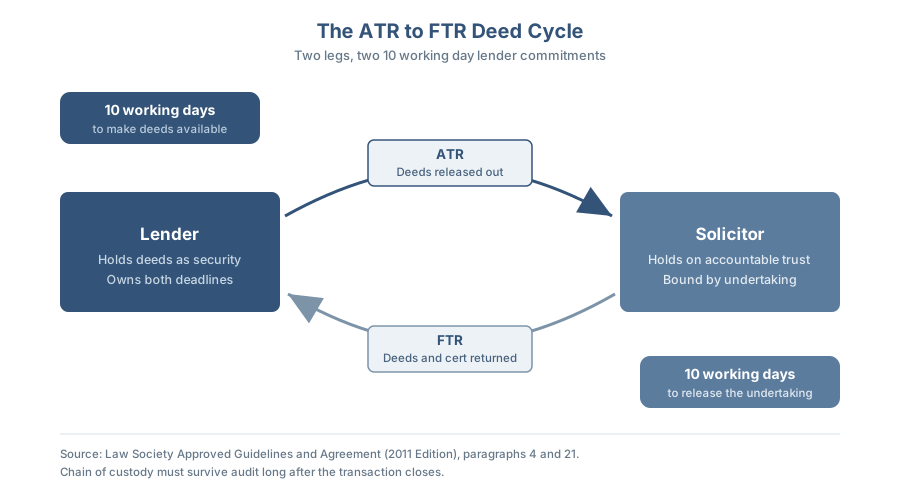
An Accountable Trust Receipt is a written arrangement under which a lender hands over original title deeds it holds as security, to a solicitor acting for the borrower, for a specific stated purpose. The solicitor takes the deeds "on accountable trust", meaning they hold them on terms that require their return and make the solicitor answerable for them in the meantime.
ATRs are requested for a defined set of reasons: a property sale, a remortgage or switch to another lender, a top-up or further advance, a transfer of ownership between spouses or family members, or the resolution of a title or planning issue that requires sight of the original documents.
The arrangement matters because in most cases the deeds are the lender's security. Releasing them without an accountable framework would mean releasing control of the asset underpinning the loan. The ATR is what preserves the chain of custody while the deeds are physically out of the institution's hands.
The Law Society Approved Guidelines and Agreement (2011 Edition) sets out what a valid request looks like, and requests that fall short of it are where the first delays creep in.
That last point has a direct consequence for the deadline, covered below.
The word "accountable" is doing real work. Once the deeds are released, the solicitor holds them under an undertaking and is answerable to the lender for their safekeeping, their use for the stated purpose only, and their return.
The lender's side of the arrangement is equally defined. It agrees not to refuse an undertaking or accountable trust receipt from a solicitor without good objective reason, and it agrees to specified turnaround times. The framework is reciprocal, which is why failures on either side have a defined escalation path rather than simply becoming a relationship problem.
A Final Trust Receipt refers to the closing leg of the deed cycle, when the transaction completes and the deeds, the mortgage or charge and the certificate of title are returned to the lender and the institution's records are updated to reflect the closed position.
A note on terminology, because it causes confusion. "Final Trust Receipt" is the operational term used across Irish banking and by service providers. The agreed guidelines themselves do not use the phrase. What they address is the furnishing of title deeds and certificate of title to the lender, and the lender's obligation to release the solicitor from the undertaking once that has happened. In practical terms these describe the same closing event, but if you are checking the agreement itself, look for the furnishing and release provisions rather than for "FTR".
Three obligations attach to the closing side:
Institutions that resource the outbound ATR queue and treat FTR as filing tend to find the backlog accumulates on the inbound side. Every unreleased undertaking is an open item on someone else's file, and it generates chasing correspondence that lands back on the same team.
|
|
Accountable Trust Receipt (ATR) |
Final Trust Receipt (FTR) |
|
Direction |
Deeds out from lender to solicitor |
Deeds and certificate of title back to lender |
|
Trigger |
Written request from the borrower's solicitor |
Completion of the transaction and the solicitor's undertaking |
|
Purpose |
Sale, remortgage, switch, top-up, transfer, title issue |
Close the cycle and restore the lender's security position |
|
Lender's core deadline |
10 working days to make deeds available |
10 working days to release the solicitor from the undertaking |
|
Main risk if missed |
Delayed customer transaction and solicitor complaint |
Open undertakings, incomplete records, audit exposure |
|
Records outcome |
Deeds recorded as out on accountable trust |
Deeds recorded as returned and file closed |
Figure 2: The two legs of the deed cycle compared.
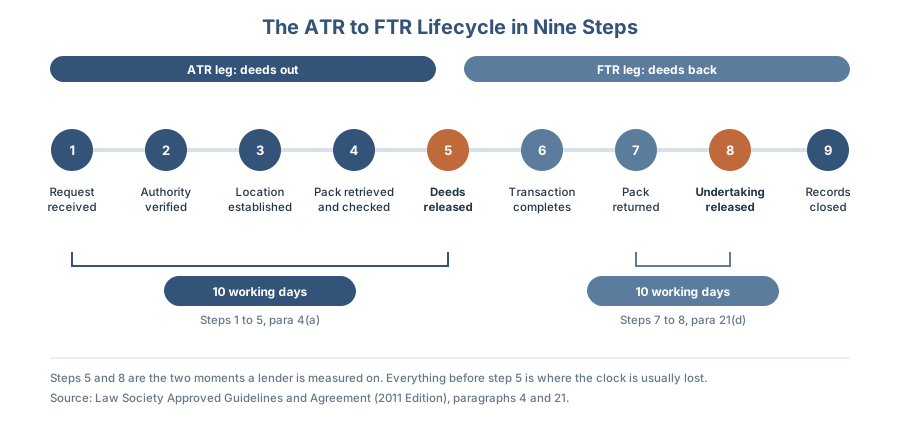
Figure 3: Steps 5 and 8 are the two moments a lender is measured on.
Nine steps, two deadlines, and a chain of custody that must survive an audit years later.
The 10 working day standard sits in the Law Society Approved Guidelines and Agreement (2011 Edition), the framework agreed between the Law Society of Ireland and participating lending institutions, dated 2 April 2012. The same framework underpins the residential mortgage certificate of title system used across the Irish market.
It is a contractual service standard agreed between lenders and the profession, not a statutory deadline. That does not make it optional. Where a lender misses it, the solicitor has a defined escalation route that terminates in the lender's regulated complaints process.
Several commitments in the agreement run on the same 10 working day clock, which is why one capacity shortfall can produce several breaches at once.
|
Lender commitment |
Timeframe |
Reference |
|
Make deeds available on ATR where the lender holds them |
10 working days from the request |
Para 4(a) |
|
Make deeds available where they are held elsewhere on ATR |
10 working days from the deeds coming into the lender's possession |
Para 4(b) |
|
Furnish redemption figures to the borrower's solicitor |
10 working days from the request |
Para 5(b) |
|
Release the solicitor from their undertaking once complied with |
10 working days |
Para 21(d) |
|
Respond to a solicitor's letter about an overdue item |
10 working days |
Para 24(a) |
|
Furnish a release, discharge or vacate |
One month from payment or request, whichever is later |
Para 23(a) |
Figure 4: Agreed lender timeframes under the Law Society Approved Guidelines and Agreement (2011 Edition).
Teams that treat every ATR request identically will breach on the exceptions. There are three distinct starting positions.
The lender holds the deeds. The 10 working days run from receipt of the written request. This is the straightforward case and the one most processes are built around.
The lender controls but does not hold the deeds. If the deeds are already out with another solicitor on accountable trust receipt, the lender must call for their immediate return. The 10 working days then run from the date the deeds come back into the lender's possession, not from the date of the request. This is the most misunderstood version of the rule, and the one most likely to sit unactioned while everybody assumes somebody else has chased it.
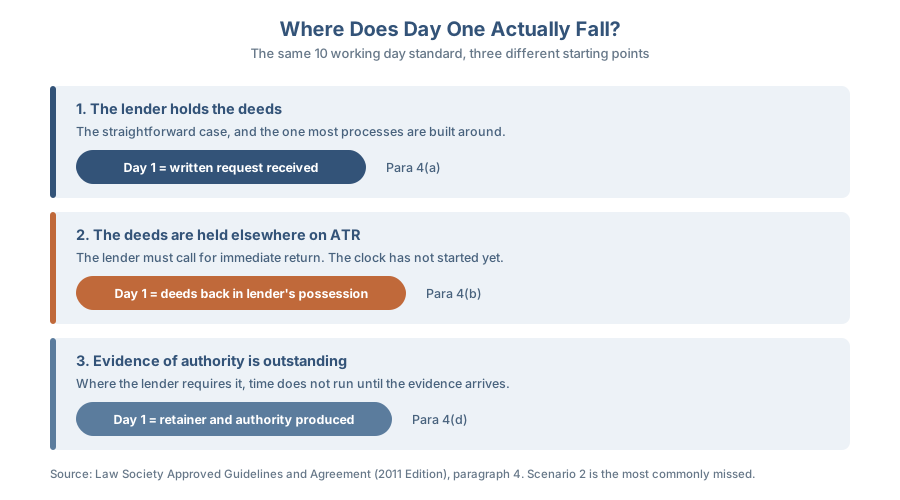
Figure 5: The same standard, three different starting points. The second is the one most commonly missed.
Evidence of authority is outstanding. Where a lender requires evidence of the borrower's irrevocable retainer and authority, and the request for that evidence is made within the original timeframe, time does not run against the lender until the evidence has been produced. Recording the exact date the evidence was requested and the date it arrived is a control, not administrative housekeeping. It is what defends the file if the timeframe is later challenged.
The failure points are consistent across institutions.
The last two are worth taking together, because they compound.
Load balancing means distributing incoming requests across all available processing capacity so that no queue breaches its deadline while capacity sits available elsewhere. It matters here because ATR and FTR demand is structurally uneven while internal team size is fixed.
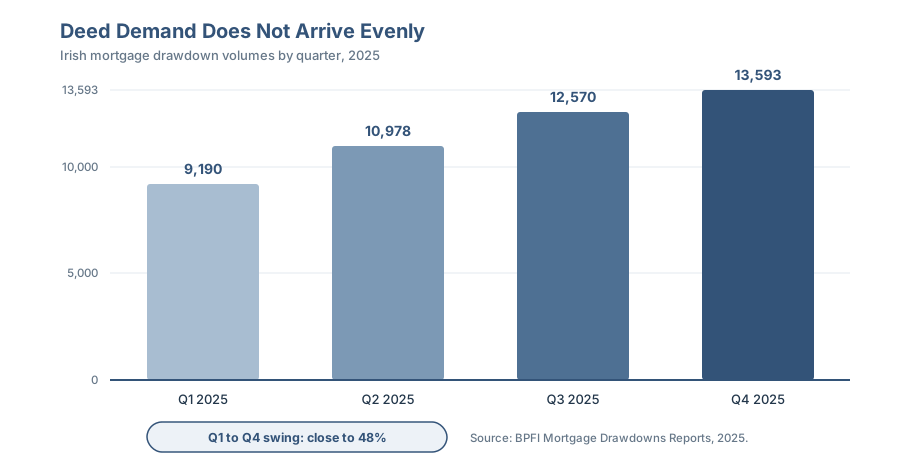
The property market does not deliver work evenly. According to Banking and Payments Federation Ireland, there were 9,190 mortgage drawdowns in Ireland in Q1 2025, rising to 10,978 in Q2, 12,570 in Q3 and 13,593 in Q4. That is a swing of close to 48% between the quietest and busiest quarters of a single year, and deed activity tracks drawdown activity.
Switching is disproportionately ATR-intensive. BPFI reported that re-mortgage and switching volumes rose 33.9% year on year in 2025. A switcher's solicitor has to take up the deeds from the outgoing lender, so every switch generates an ATR. Switching is rate-driven, which means it does not ramp gently, it arrives in bursts.
Figure 6: Irish mortgage drawdown volumes by quarter, 2025. Source: BPFI.
Portfolio events are lumpier still. Securitisations, loan sales, servicer migrations and audit exercises generate concentrated deed activity that has nothing to do with the underlying market.
Three conditions have to hold for load balancing to actually work:
The 10-day deadline is rarely lost on day 10. It is usually lost on day one or day two, while a request sits unrouted in a shared inbox, or while nobody has yet established that the deeds are held elsewhere on accountable trust receipt.
By the time a request is visibly late, the recovery options are limited and expensive. The institutions that hold the standard reliably tend to share one characteristic: somebody owns the queue as a whole, rather than each person owning their own share of it.
The escalation path is defined, which is what gives a service standard regulatory weight.
A solicitor concerned that a lender has missed an agreed timeframe writes to the lender. The lender must respond within 10 working days, either by furnishing the outstanding item or by giving a good reason for the delay, which the solicitor should not unreasonably reject. If that does not resolve matters and the solicitor intends to complain, the lender is afforded a further 10 working days. At that point the complaint is treated as a customer complaint, with referral to the Financial Services and Pensions Ombudsman available if it remains unresolved.
One point of currency worth noting. The guidelines were drafted against Provision 10.9 of the Consumer Protection Code 2012. That Code has since been replaced. The Consumer Protection Code 2025 took effect on 24 March 2026 following a 12-month implementation period, so the complaints-handling requirements a lender must actually apply today are those in the current Code and its associated regulations, not the 2012 provision the guidelines cite. The escalation route is unchanged in substance. The reference point has moved.
Nothing in the guidelines restricts other remedies where a solicitor or their client reasonably believes the delay may cause financial loss or prevent them meeting contractual obligations to a third party. In a chain sale, that is not a theoretical risk.
The commercial consequences run alongside. A delayed ATR holds up a sale, switch or remortgage for a customer with a closing date. It strains relationships with the solicitor firms that route business toward or away from a lender. And under the Individual Accountability Framework and SEAR, operational failures of this kind sit with a named senior individual rather than with a department.
Kefron's Banking Support Services provide structured ATR and FTR management as a managed service, built around deadline protection rather than storage alone. Every ATR and FTR is tracked in one place with full audit trails and deadline monitoring, and the service operates regardless of where the deeds are currently held. Securities document validation checks deed-pack contents and signatures against AML, KYC and legal requirements, which is what moves the discovery of a missing document from release day to retrieval day.
The scale is what makes balancing possible. Kefron manages more than 700,000 deeds across 13 secure vaults, and consolidated over 62,000 customer loan packs for Dell Financial Services from multiple European storage vendors into a single fully indexed system with complete track-and-trace visibility. A major Irish bank digitised and analysed 15 million records with Kefron to support regulatory compliance.
For institutions that also need physical custody, Kefron provides climate-controlled vault and deed storage with full chain of custody logging.
→ Download the Deeds and Securities Management Brochure
→ Talk to the Kefron banking team
An Accountable Trust Receipt is the mechanism by which a lender releases original title deeds to a solicitor for a stated purpose, such as a sale, remortgage or switch. The solicitor holds the deeds on accountable trust, which creates a formal obligation to use them only for that purpose and to return them.
An FTR is the operational term for the closing leg of the deed cycle, when the deeds and certificate of title are returned to the lender, the solicitor is released from their undertaking and the institution's records are updated. The agreed guidelines address this as the furnishing of title deeds and the release from the undertaking rather than as "FTR".
An ATR governs deeds going out from the lender to a solicitor. An FTR relates to the pack coming back in and the file being closed. Both carry a 10 working day commitment from the lender, but for different actions.
Where the lender holds the deeds, the agreed timeframe is 10 working days from receipt of the solicitor's written request, under the Law Society Approved Guidelines and Agreement (2011 Edition).
The lender must call for their immediate return. The 10 working days then run from the date the deeds come into the lender's possession rather than from the date of the request.
Yes, in one defined circumstance. Where a lender requires evidence of the borrower's irrevocable retainer and authority, time does not run against the lender until that evidence has been produced.
The request must be in writing, state the purpose for which the deeds are needed, and contain sufficient detail for the lender to identify the property. The solicitor must also hold the borrower's irrevocable retainer and authority.
A lender should not refuse an undertaking or accountable trust receipt from a solicitor without good objective reason. Lenders may, however, operate policies on accepting undertakings where a conflict of interest is perceived.
The solicitor writes to the lender, which must respond within 10 working days. If unresolved and a complaint is intended, the lender is given a further 10 working days. The complaint is then handled as a customer complaint under Provision 10.9 of the Consumer Protection Code, with referral to the Financial Services and Pensions Ombudsman available afterwards.
No. Accountability for outsourced activity remains with the institution. What changes is who executes the process, and whether that execution is backed by defined service levels, live reporting and an auditable trail.
ATR and FTR are not filing tasks. They are the two halves of a controlled release and return of the asset securing a mortgage, governed by an agreed framework with defined deadlines on both sides and a formal escalation route when they are missed.
The 10 working day standard is not hard to meet in a normal week. It becomes hard when a switching wave, a portfolio migration and a fortnight of annual leave land in the same month and a fixed team is asked to absorb all three. The institutions that hold the line do it with three things: visibility of the queue, capacity that can flex, and the discipline to route by deadline rather than by arrival.
.png?width=500&height=500&name=Email%20Tiles%20Templates%20(20).png)