
Mastering Invoice Matching: Three-Way, Line Item & PO Matching Explained
Explore the essentials of three-way matching, PO matching, and line item matching for accurate,...

Retail invoice processing is becoming increasingly challenging as physical store networks face growing pressure to manage costs, maintain operational efficiency and comply with financial regulations. Behind every store is a complex web of supplier invoices covering everything from rent and utilities to cleaning services, merchandising and store maintenance. When processed manually, these invoices create bottlenecks, errors, overspending and poor visibility.
Traditional retail invoice processing relies on paper, email attachments, spreadsheets and manual approvals. This approach is slow, labour-intensive and offers little visibility across multiple locations. It also increases the likelihood of late payments, duplicate invoices and compliance risks.
Modern solutions built around retail automation, accounts payable automation and AI in retail finance are changing this landscape. Retailers are now using digital invoice workflows to streamline approvals, eliminate manual data entry and improve cost control across their estates. This blog explores the challenges of manual processes, the role of automation, and the steps retailers can take to modernise their finance operations.
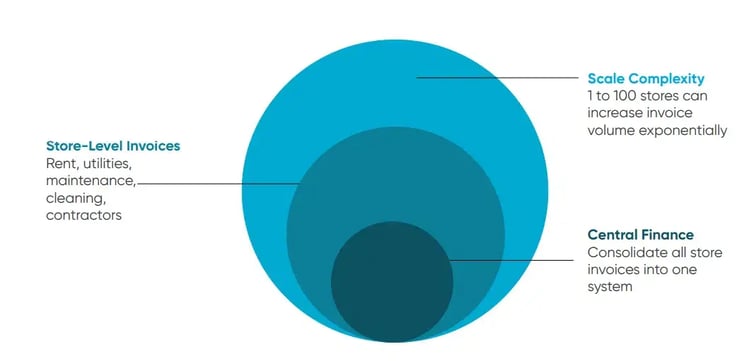 Diagram showing the complexity of retail invoice processing across store-level invoices, central finance consolidation and scaling from 1 to 100 stores.
A store-based retailer may receive thousands of invoices every month across dozens or hundreds of locations. Each store deals with different utility providers, waste contractors, local suppliers, and facility management vendors. Invoices arrive by post, email, PDF or portal downloads, and formats vary widely.
Without automation, finance teams must manually compile, sort and input invoices before matching them to purchase orders or budgets. This decentralised and fragmented model makes it difficult to consolidate spend, track status or ensure timely payment.
Human data entry, chasing approvals and searching for supporting documents consume valuable time across finance and operations teams. A single incorrectly entered decimal point can delay payment or distort financial reporting. According to industry benchmarks, manual invoice processing can cost up to five to seven times more per invoice than automated alternatives.
Additionally, when store managers are required to approve invoices via email or paperwork, they lose focus on customer-facing responsibilities. Finance specialists then spend time following up on overdue approvals or querying missing details.
Manual processing makes it difficult to see outstanding liabilities in real time. Retailers often face month-end surprises due to delayed invoices, unapproved costs or unexpected supplier charges. Without central oversight, duplicate or fraudulent invoices can go undetected.
Compliance is another growing concern. With evolving regulations such as Making Tax Digital in the UK, retailers must be able to track, audit and report financial data accurately. Manual workflows make this significantly harder to achieve at scale.
Traditional invoice handling relies on data entry, email approvals and document chasing — all of which consume time and create friction across store and finance teams. Accounts payable automation for retailers replaces these manual touchpoints with digital capture, central routing and automatic approval workflows. Instead of invoices sitting in inboxes or on desks, they move through one controlled system.
For growing retailers, this shift is critical. As store numbers rise, invoice volume increases exponentially. Without automation, headcount has to scale alongside the workload — driving up costs and slowing operations. Automated workflows allow retailers to increase invoice volume without increasing administrative pressure.
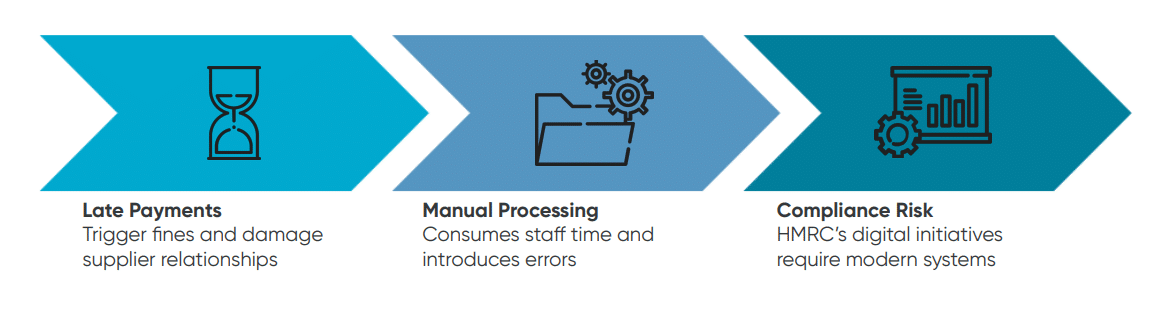 Graphic showing key challenges of manual retail invoice processing, including late payments, manual workloads and compliance risk due to HMRC digital requirements.
Modern automation platforms typically deliver a combination of features that directly address retail pain points:
Automated invoice capture – AI and OCR extract data from PDFs, emails, scans or e-invoicing formats, reducing manual input.
Two-way and three-way matching – Invoices can be automatically matched against purchase orders and goods received, eliminating delays in verification.
Approval routing – Invoices are directed to the right store manager, department head or regional approver based on rules, rather than email chains.
Full visibility and tracking – Finance teams gain a real-time dashboard of every invoice, its status, and any exceptions waiting for review.
ERP and accounting integration – Approved invoices flow directly into finance systems without rekeying.
Digital audit trails – Every approval, change and timestamp is recorded automatically.
These capabilities remove the need for spreadsheets, physical files and fragmented communication between stores and head office.
Retailers who adopt retail automation for invoice processing consistently report measurable improvements:
Faster approvals – Some retailers reduce cycle times from weeks to days or even hours.
Reduced costs per invoice – Manual processing can cost £10–£15 per invoice, while automation can bring that down to under £3.
Elimination of late payment penalties – By removing administrative backlogs, payments are made on time.
Stronger supplier relationships – Consistent, accurate payments build trust and improve terms.
Better control of spend – Finance teams can monitor liabilities in real time and spot cost anomalies early.
Scalability without extra headcount – New stores can be onboarded without overwhelming finance teams.
Automation turns accounts payable into a controlled, visible and scalable process rather than a reactive administrative burden.
While automation streamlines workflows, AI in retail finance adds intelligence and adaptability. Instead of relying solely on static rules, AI can interpret complex invoice layouts, learn from previous data, and improve over time. This is especially valuable for retailers dealing with thousands of supplier formats, seasonal cost fluctuations and regional invoice variations.
AI-driven invoice processing enables faster decision-making, reduces exceptions and supports finance teams in handling higher volumes with greater precision.
Retailers are beginning to adopt AI capabilities that directly impact performance, such as:
Automated recognition of invoice layouts, even when formats differ
Line-level data extraction with high accuracy
Predictive identification of duplicate or suspicious invoices
Detection of anomalies based on historical spend patterns
Intelligent matching when PO, invoice and delivery data are not perfectly aligned
Prioritisation of invoices that need urgent review or approval
These features reduce human intervention, speed up payment cycles and help retailers avoid costly errors.
With AI-enabled invoice processing, finance leaders gain clearer oversight of commitments and risks. Real-time insights into spend trends help with budgeting and cash flow forecasting. AI can also surface issues before they escalate — such as unexpected supplier rate changes or inconsistencies in recurring invoices.
Combined with automated workflows, AI helps turn accounts payable into a proactive and strategic function rather than a back-office process.
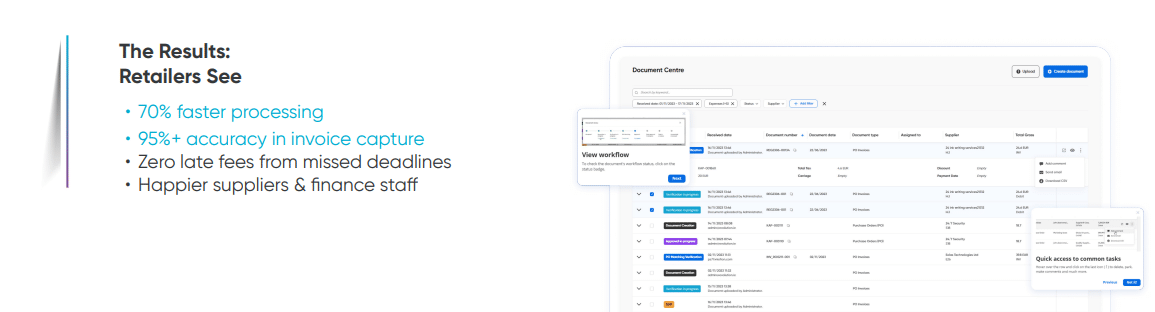 Results of retail invoice automation showing 70 percent faster processing, over 95 percent accuracy in invoice capture and a digital dashboard view of automated workflows.
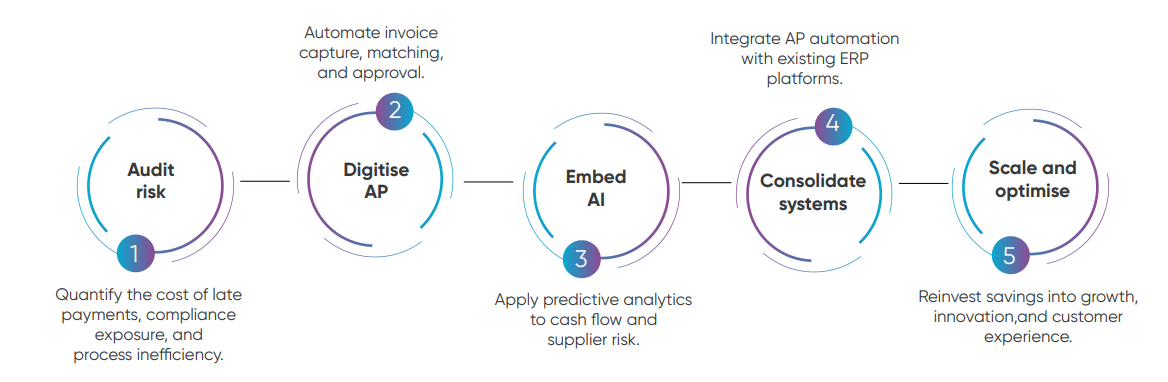 Five-step roadmap for transforming retail invoice processing, starting with auditing risk, digitising accounts payable, embedding AI, consolidating systems and scaling for optimisation.
Retailers should begin by understanding how invoices currently flow through their organisation. Map out the number of invoices per month, processing time, approval paths, error rates and staff effort. This helps build the business case and identify priority areas.
Scan or ingest invoices through email forwarding, upload portals or API connections. This removes paper and decentralised storage, enabling central oversight and transparency across all stores.
Introduce automated two-way or three-way matching and route invoices to store or regional approvers based on rules. This eliminates delays caused by email threads or manual forwarding.
Connecting an accounts payable automation platform with ERP or accounting software streamlines posting and reconciliation. It also supports audit preparation and month-end reporting.
Once automation is embedded, AI can take invoice processing further by reducing exceptions, flagging irregularities and improving forecast accuracy. At this stage, finance teams start moving from transactional workload to analytic and strategic activity.
Retailers that continue relying on manual invoice processing face rising costs, higher compliance pressure and limited visibility across store networks. As invoice volume grows with every new location, traditional workflows simply cannot scale without adding time and headcount.
By adopting accounts payable automation for retailers, supported by retail automation and AI in retail finance, finance teams can eliminate inefficiencies, accelerate approvals and gain real-time oversight of liabilities. Automation reduces errors, prevents late payments and ensures every invoice is tracked from receipt to reconciliation.
This shift doesn’t just improve operations — it futureproofs finance as regulations evolve and store networks expand. Retailers ready to modernise their invoice processing can move quickly, starting with digitisation and scaling towards AI-enabled intelligence.