US finance research · 2026
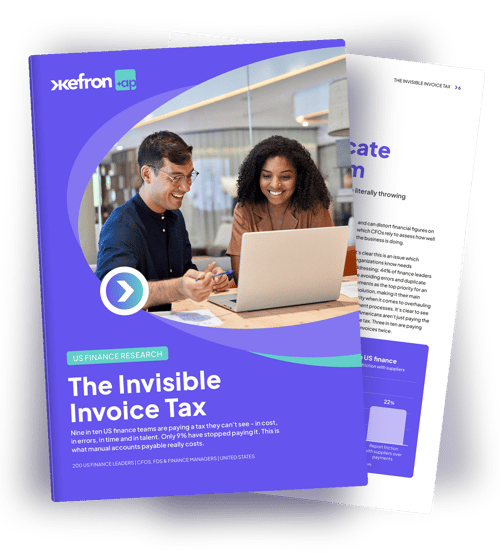
The Invisible Invoice Tax benchmarks 200 US finance leaders on what manual accounts payable really costs: in cost, errors, time and talent. Find out where your team stands, what triggers change, and how the 9% stopped paying.
The invoice tax, in numbers
still rely on manual steps to pay invoices
say skilled people's time is wasted on manual finance tasks
report duplicate or erroneous payments
Censuswide survey of 200 US finance professionals for Kefron. Figures rounded.
Research Report
An independent benchmark of 200 US finance leaders on what manual AP really costs - in cost, errors, time and talent - the moments that force change, and how the 9% stopped paying.
Inside the report
of US finance teams have fully automated AP. The other 91% are still paying the tax.
are paying some invoices twice, through duplicate or erroneous payments.
name rising invoice processing costs, the most-cited AP challenge.
would invest in AP automation when invoice volume rises, 9 points above the global average.
Source: Kefron / Censuswide survey of 200 US finance professionals (global comparison: 1,200 across six markets). Figures rounded.
From the findings to the fix
Every pain point US finance leaders reported has a fix. Here's how Kefron AP removes each one, and what our customers see when it does.
The tax
The fix →
More than 70% of Kefron customers' invoices go through with no human intervention, contributing to an average 67% fall in AP processing costs.
The tax
The fix →
Configurable workflows send every invoice to the right approver automatically, clearing the bottlenecks that build up as approval chains grow.
The tax
The fix →
AI capture with human validation reaches 99% accuracy and cuts time spent on manual AP processing by 80–85%.
The tax
The fix →
Invoices, payments and statements are cross-checked automatically, so duplicates are caught before the money leaves. It's the #1 priority for 44% of US teams.
The tax
The fix →
Live dashboards show where every invoice is, giving finance leaders accurate data to forecast, plan and answer the auditor.
The tax
The fix →
Connects to 70+ accounting and ERP systems, so AP improves alongside what you already run. No rip-and-replace, no disruption.
The control gap
What they know
What they're missing
Highest of six markets. US teams are 11 points above the global average on not being able to fix known AP delays.
Share of US finance teams who agree (n=200). Kefron / Censuswide. Figures rounded.
US finance leaders aren't in the dark. 85% agree accurate invoices make financial reporting more reliable, and the same share know that automating AP cuts compliance risk and audit stress.
The problem is control. Two-thirds say their current systems stop them from fixing AP delays they already know about. That's the highest of any market surveyed.
When the numbers behind month-end can't be relied on, boards and investors notice, and growth plans get harder to back. No wonder 77% say manual AP makes it harder to scale.
We make yearly acquisitions, increasing our finance team’s workload. To expand without adding repetitive tasks like invoice processing, we adopted Kefron AP. Their software efficiently extracts 99% of invoice data on the first attempt.
Tomasz Sobczyk,
IT Project ManagerWe selected Kefron for global AP automation due to their unique ability to handle both AP automation and global e-invoicing. With e-invoicing becoming a legal necessity in Europe, it’s essential to have documents in government-approved formats.
Stephanie Riera,
Group Director of Finance & TransformationGetting one global view and streamlined process was important for us as a group as it reduces time to pay suppliers, makes training for our own staff easier and provides more clarity and accuracy on reporting.
Paul McMahon,
Head of Finance TransformationBenchmark your AP
See how your team compares with 200 US finance leaders: what manual AP is costing them, the moments that force change, and how the fully automated few stopped paying.
Where does your AP sit? US finance teams by level of AP automation
Kefron / Censuswide survey of 200 US finance professionals. Figures rounded; total 100.
It's an independent benchmark of 200 US finance professionals, carried out with Censuswide. It shows what manual accounts payable really costs in money, errors, time and talent, the events that push teams to act, and what changes for organizations that automate. It also lets you see where your own AP maturity stands.
It's the hidden cost of processing invoices by hand. Every manual step, from keying in data to chasing approvals, matching and filing, adds cost that rarely shows up as a line on the P&L. Rising processing costs are the most-cited AP challenge in the US (38%), and 3 in 10 teams are paying some invoices twice.
More growth means more invoices, approvers and suppliers, so every manual step is repeated more often. 77% of US finance teams say manual AP makes it harder to scale, and 83% say a rise in invoice volume would push them to invest in automation. As the report puts it, growth doesn't shrink the invoice tax; it multiplies it.
Control. Seven in ten UK CFOs admit their current systems don't give them the oversight to fix known AP delays, and 68% believe skilled people's time is being wasted on manual finance tasks. When the numbers feeding month-end can't be fully trusted, it's the person presenting them - not the system - who takes the credibility hit.
CFOs and finance directors seeking greater control, heads of finance managing a growing team, and any business leader weighing up their operational infrastructure. If AP feels like it's straining against growth rather than supporting it, the benchmark offers a clear-eyed view of where you stand and what to do next.