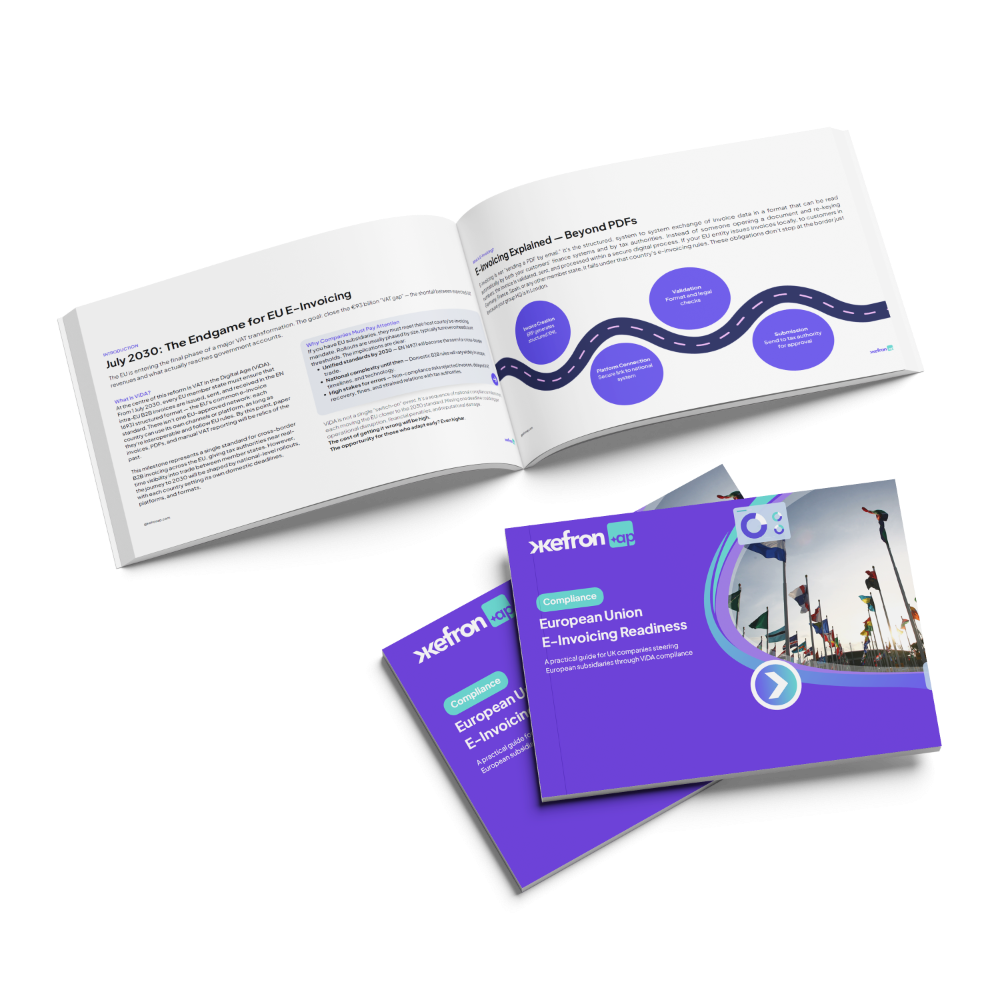
Guide:
ViDA Compliance for EU Finance Teams: What You Need to Know
The EU’s ViDA reform is transforming invoicing across member states. This guide explains EU e-invoicing deadlines, compliance risks, and how finance teams can prepare.
In our guide “ViDA Compliance for EU Finance Teams”, you’ll:
- Track EU e-invoicing deadlines by country.
- Understand EN16931 invoice standards.
- See how PEPPOL supports ViDA compliance.
- Identify risks of non-compliant invoices.
- Build a ViDA rollout plan for subsidiaries.
Download this guide:

Why ViDA Compliance Matters Now
Across Europe, governments are introducing structured e-invoicing mandates to improve tax transparency and close the €93 billion VAT gap. Each EU country is setting its own deadlines, formats, and reporting rules. For organisations operating across multiple jurisdictions, preparing early helps reduce compliance risk, avoid rejected invoices, and maintain stable payment cycles.
What Global Finance Leaders Are Saying

How Finance Teams Manage ViDA Compliance
Kefron helps finance teams achieve ViDA compliance through structured invoice validation, platform connectivity, and secure archiving across multiple EU jurisdictions.

Country Compliance Mapping
Track EU e-invoicing mandates, deadlines, and reporting platforms across subsidiaries to maintain consistent planning.

EN16931 Invoice Validation
Generate and validate structured invoices aligned with EN16931 standards and local formats required for EU compliance.

PEPPOL Connectivity
Transmit invoices through PEPPOL and national tax authority platforms while maintaining secure and compliant data exchange.

Real-Time Invoice Visibility
Monitor invoice submission, validation results, and delivery status across EU platforms to maintain control of operations.

Compliant Invoice Archiving
Store invoices securely with compliant electronic archiving to support audits, VAT reporting, and legal retention requirements.

ERP-Ready Integration
Connect your finance systems once and manage EU e-invoicing compliance across multiple countries without complex rebuilds.

Start Preparing for ViDA Compliance Today
Download the guide to understand EU e-invoicing deadlines, ViDA compliance requirements, and the steps finance teams can take to prepare.
Frequently asked questions:

What is ViDA compliance?
ViDA compliance refers to meeting the requirements introduced by the European Union’s VAT in the Digital Age (ViDA) initiative. These reforms are designed to modernise VAT reporting and introduce structured EU e-invoicing compliance across member states. Businesses must generate invoices in approved formats, transmit them through compliant networks, and maintain secure digital records that meet national tax authority requirements.
When will EU e-invoicing become mandatory?
The EU plans to standardise cross-border B2B e-invoicing across member states by July 2030 under the ViDA framework. However, many countries are introducing their own national mandates much earlier. These phased EU e-invoicing deadlines vary by country and sometimes by company size, meaning businesses operating across Europe must track multiple timelines simultaneously.
What is EN16931 and why does it matter?
EN16931 is the European standard for structured electronic invoices. It defines how invoice data should be formatted so it can be processed automatically by accounting systems and tax authority platforms. Many EU e-invoicing mandates require invoices to follow EN16931-compliant formats, ensuring interoperability across different countries and digital networks.
What role does PEPPOL play in e-invoicing?
PEPPOL is a secure network used to exchange structured electronic documents, including invoices, between organisations. It follows a four-corner delivery model where businesses connect through certified access points. Many EU countries rely on PEPPOL e-invoicing infrastructure to support compliance with national mandates and future ViDA requirements.
Do UK companies need to comply with ViDA rules?
Yes. Even though the UK is no longer part of the EU VAT system, UK companies with subsidiaries operating within EU member states must comply with the e-invoicing regulations of each country where they do business. This means those entities must meet local formats, platforms, and reporting requirements introduced under national ViDA-aligned mandates.
What happens if invoices are not compliant?
Non-compliant invoices may be rejected by tax authority platforms or customers’ finance systems. This can delay payment processing, interrupt VAT reporting, and create operational bottlenecks for finance teams. Repeated non-compliance may also expose organisations to penalties, audits, or increased scrutiny from tax authorities.
How can finance teams prepare for ViDA compliance?
Finance teams should begin by mapping which subsidiaries are affected by national e-invoicing mandates and identifying upcoming EU e-invoicing deadlines. From there, organisations typically evaluate invoice formats, ERP integrations, and connectivity to platforms such as PEPPOL or national tax portals to ensure invoices can be generated, validated, transmitted, and archived compliantly.
Why are governments introducing e-invoicing mandates?
E-invoicing mandates are designed to improve tax transparency and reduce fraud by giving authorities near real-time visibility into transactions. These reforms aim to close the EU’s €93 billion VAT gap, while also helping businesses adopt more efficient digital invoicing processes and reduce manual financial administration.